




It’s an uncharacteristically cool afternoon in Dubai, and a refreshing Gulf breeze brushes through me as I make the journey towards KIT Digital in Media City. KIT’s office itself is unprepossessing enough, an ocre and magnolia space with the odd travel memento here and there. My photographer struggles to find a spot with anything interesting in the background, settling eventually on a strange tribal statue that didn’t make the final edit for being, well, boring.
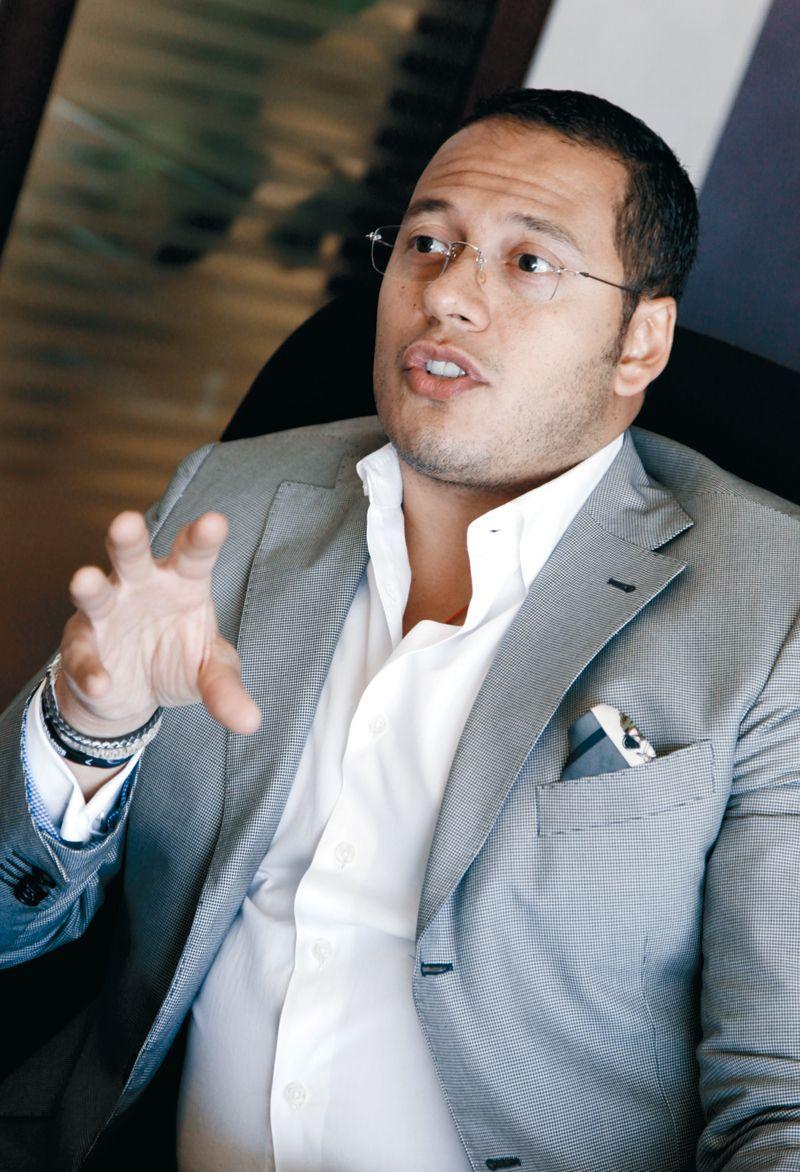
But any sense of accidie is quickly evacuated when Kaleil Isaza Tuzman, KIT’s capricious chairman and CEO, shakes my hand and takes a seat opposite his desk. Tuzman is instantly affable with a disarming smile. So it’s almost a surprise when he instantly kicks into conversation about the company’s aggressive market strategy, which borders on all-out assault. 2010 saw KIT swallow up Singapore’s Benchmark Broadcast Systems (US$ 9.5m), UK-based Megahertz Broadcast Systems (US$ 4.7m) and, in September, Brickbox Digital Media (for around US$ 11m).
Gulp. So why all the M&A action? “Brickbox provided us very strong relationships with the Hollywood studios,” says Tuzman. “Brickbox has an office in Los Angeles, and has been doing mezzanine file management and digital cinema prep with Hollywood for many years, and is probably the strongest mezzanine file management company for the European market. That was part of our original rationale for the move to Prague, even though it took a couple of years to push things through.”
But it was KIT’s September acquisition of Megahertz, a UK firm which has pioneered digital video integration for over twenty years, which caused a stir at IBC and beyond. “KIT digital is clearly emerging as a company that understands the changing media and entertainment environment, where consumers can access content anywhere, any time and on any device,” said Megahertz MD Frances Jarvis. Tuzman claims the Megahertz sale allows KIT to offer clients a smoother step between old and new technology. “Megahertz has been doing business here in the Middle East since the 1980s,” he says. “It has worked with a number of broadcasters here in Media City, on broadcast systems integration capability. And we’re really a company that’s committed to bridging the old and the new in technology, unlike some companies that are purely web-oriented.
“Rather than jump directly from traditional digital technologies, file-based workflow, to this new cloud-based world, we understand that you need to hold the client’s hand and go through that process,” adds Tuzman. “So we have pretty strong services divisions – over 250 people – working on moving from traditional cloud-based infrastructure and digital video workflow, to open architecture and IP-based workflow. And the Megahertz team, as a BSI (British Standards Institution) company, have been doing that for a long time, and have provided a lot of those relationships. In fact the former CEO of Megahertz is now an executive within KIT Digital, because we don’t use the different brands. We integrate quite quickly.”
All the activity appears to be paying off: this year KIT expects to break the US$ 100m mark in revenues, just a year after registering US$ 47m. Its EBITDA (earnings before interest, taxes, depreciation and amortisation) has also shot up, from US$ 4.8m in 2009, to a predicted US$ 18m in 2010, and US$ 32m this year. Tuzman tells me that KIT now commands roughly a quarter market share, vastly outstripping its closest competitor, thePlatform, which rakes in around US$ 45m in revenues. KIT’s market capitalisation today stands as testament to its lightning-fast growth, exploding from US$ 10m in 2007 to around US$ 430m today.
KIT has wasted no time in releasing its core product, VX-one: an end-to-end solution for IP-based video delivery. The platform is split into three components. “VX Media Suite is a software tool for corporations to use video online and on mobile devices to market and merchandise products, to communicate more effectively internally, for HR and training, for example,” says Tuzman. “VX Vision is a platform for broadcasters, help them manage content input from single-file formats, and have those published on many different devices. VX Enterprise is an industrial video platform for network operators; for telcos and cable systems, to run big-scale VOD stores and IPTV cable systems.”
Tuzman estimates that around 40 to 45 per cent of KIT’s business comes from ‘back-end’ clients, including large pharmaceutical companies, banks, governments, non-profit and faith-based organizations, automotive and CPG companies. The other 50 to 55 per cent is drawn from media and entertainment, or ‘front-end’ clients, including MSOs, telcos, content providers and syndicators and IPTV cable providers.
Tuzman feels this three-pronged approach is vital for a region experiencing huge discrepancies in internet infrastructure. “I don’t think it’s possible to have a one-size-fits-all offering for the region, and I think some of our smaller competitors make that mistake,” he says. “That’s why we have three different products, which are appropriate to different bandwidth environments. Our lightest offering, VX Media Suite, can be easily used in a low bandwidth environment, whereas VX Enterprise is more for true IPTV cable and dedicated network environments, or hybrid network environments.”
Yet the enigmatic CEO is sure that bandwidth isn’t the main issue facing the region, and the UAE in particular, where Tuzman insists the company would be headquartered but for a handful of reasons. “I don’t think the challenge in MENA is bandwidth, because the free market will eventually prevail,” he says. “But generally speaking, people demand high bandwidth connections, and they’ll get them over time. The challenge from a business perspective is the core infrastructure.
“When it comes to cloud computing, and moving to IP workflow, remote hosting, connectivity, data centre costs, downlink, and uplink are vital infrastructure components. And until recently, companies here in Dubai Media City, or Dubai Internet City, were dealing with a monopoly with Samacom, as part of the du group. The problem from a pricing perspective, is that any time you have a monopoly, you’re going to have bad pricing. Now Etisalat can compete, and has reduced the prices of some of these uplink and downlink services, and some connectivity, but we were running up to five times the cost of certain other places. Maybe now we’re thirty or forty per cent higher than other similar centres, but that’s still unacceptable.”
Tuzman insists that, while Dubai is a great city with huge ambitions, it still has some way to go if it is to attract the cream of the IP crop. “Dubai has done a good job attracting production studios, so I think there has been a good effort in upgrading its components, but when you talk about networks, and the real data structure capacity, we still only have two fibres coming into the country and you don’t have a lot of redundancy in networks. Dubai also has very high-cost data centres, and high-cost uplink and downlink services. So if it wants to be a hub for cloud-based computing, it needs to change: the costs are not globally competitive.
“Immigration caused some issues, too,” he adds. “Sure, if you’re a British citizen, South African or Canadian, it’s not going to be that difficult, but in my industry I’m recruiting people out of IIT, in India, Pakistan, Vietnam, because that’s where really great technical talent is coming from at reasonable prices. The attraction of Dubai is that it’s a global cosmopolitan city, close to low-cost technical talent centres. The idea is magical: you can recruit talent from across the world, and have a great lifestyle, but also great technical talent. But it doesn’t work in practice because you need low-cost data infrastructure, at good quality of service, and you also need fluidity and less bureaucracy in the immigration process. If you don’t have that, an entrepreneur like me will set up somewhere else.”
Hence KIT’s decision in 2009, to switch its operational headquarters from the Emirates to Prague, the pretty capital of the Czech Republic. “Dubai has all the structural advantages; it’s Dubai’s to lose because it is the most cosmopolitan, good tax regime, great airport – it’s got what it needs but we live in a very competitive world. I’m vocal about it because I love the place, I own a home here. I’d love nothing more than for my company to be based here. But we have to go to wherever makes sense for the business, and that’s why we decided 18 months ago to move to Prague.”
Piracy is another issue which blights the MENA region more than most. It has spurred countless pledges and promises to shut down illegal distribution and reception of signals and online content, including last month’s from Orbit Showtime Network. Yet Tuzman feels the Middle East’s major players are missing the point. “I think content security around video is a bit of a red herring,” he says. “At the end of the day, you really do need dedicated support through a content delivery network to effectively provide video to an end-user through IP. If that’s the case you have a great deal of visibility and control over what content is being run through the system. When a market is going through the early stages in its development, there are going to be illicit portals that are illegally distributing movies and other content. But it has, over time, been beaten by a higher quality product that is being served by a dedicated CDN. it’s much more easier to identify than audio, and it’s much easier to embed security features in those files in terms of when it can be shown or opened and when it can be copied.
“When the market is in a very early stage of development and there isn’t a clear path to monetisation, people take a ‘who cares’ attitude to content,” adds Tuzman. “I won’t name the broadcasters, but I’ve been with a couple of broadcasters in the region who know that some of their content is being stolen and presented in certain portals, and they see it as a marketing opportunity. They know that not a lot of their content is there, they know that it might not be of the same quality, but they know that it’s getting some attention and they think that some material percentage of those users is going back to consume that content in an authentic environment.”
With 650 employees in 18 countries, and clients in 45 countries, you can hardly blame Tuzman and KIT for its operational Dubai exit, although the firm clearly still sees the Middle East as an exciting frontier in the world of IP video solutions.
Indeed, Tuzman notes that the UAE has been improving steadily over the years he has been a resident. “Margaret Mead once said, “Never doubt that a small group of committed people can change the world.” That’s the only way it’ll ever change. I think there is a committed, small group of people here,” he says. “I’m too much of a small fish to know what is going on behind closed doors at leadership level. I do know that there are people who identify the issue, and who are committed to making change. But I’ve been here six years, and I’ve seen prices come down, and the quality of service has got better. So changes have been made, but not at the speed they need to be, and not catching up with other places.”
With a rapid expansion the envy of most in the industry, an encompassing client offering and connections to the world’s biggest creators and distributors, it appears KIT is poised to make 2011 its own. KIT is OK: the real question could be whether the Middle East can keep up with the pace of IP enterprise. It could be a tricky year.
Follow us on

