





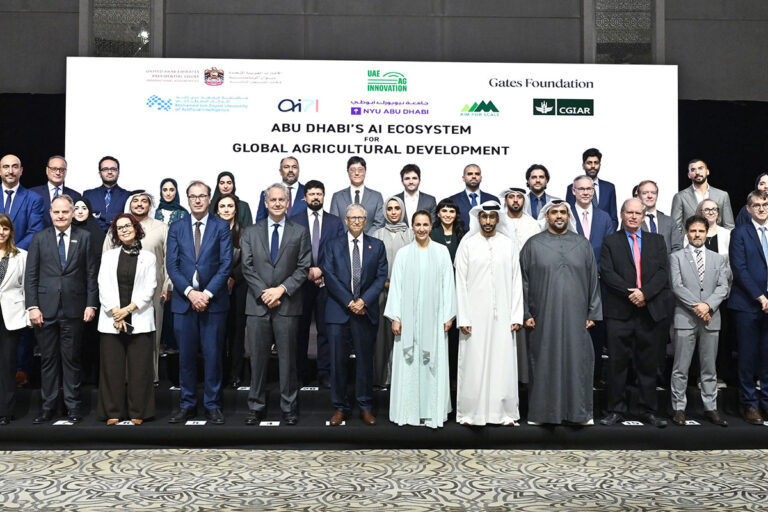
The United Arab Emirates (UAE) has launched Abu Dhabi’s AI Ecosystem for Global Agricultural Development, a new platform designed to deploy advanced artificial intelligence tools to farming regions most exposed to climate change.
The initiative builds on the US$200 million UAE–Gates Foundation partnership announced at COP28 to accelerate agricultural innovation and was unveiled in the presence of Mariam Almheiri, Head of the International Affairs Office at the UAE Presidential Court, and Bill Gates, Chair of the Gates Foundation.
After the announcement, Almheiri and Gates took part in the UAE–Gates Partnership Showcase, which demonstrated how Abu Dhabi’s scientific research capacity, technological infrastructure and AI expertise are being combined to support smallholder farmers around the world.
AI for global agricultural innovation
Almheiri said, “The UAE is harnessing artificial intelligence for global good, to help protect the farmers and communities most exposed to climate volatility. By connecting our national research and AI capabilities with leading global partners, we are turning science into real tools that reach people on the ground.”
Gates noted that smallholder farmers “are facing the harshest impacts of climate change with the fewest tools to adapt” and said the new ecosystem will help deliver “practical, data-driven solutions directly in farmers’ hands.”
The ecosystem is a collaborative network linking the International Affairs Office, Mohamed bin Zayed University of Artificial Intelligence (MBZUAI), NYU Abu Dhabi and ai71 with international partners including the Gates Foundation, CGIAR and the World Bank.
Together, they are creating a unified system that turns scientific discovery and AI models into on-the-ground digital tools, advisory systems and climate-adaptation solutions for governments, development agencies and farming communities.
Four major initiatives form the backbone of the ecosystem. The CGIAR AI Hub, hosted in Abu Dhabi by ai71, will act as a global collaborative workspace, drawing on more than 50 years of CGIAR agricultural data and expertise across 13 research centres.
The Institute of Agriculture and Artificial Intelligence (IAAI), based at MBZUAI, will provide digital advisory tools, training and technical assistance to strengthen food security and improve the livelihoods of more than 43 million smallholder farmers.
AgriLLM, an open-source agricultural large language model developed by ai71, has been trained on extensive datasets including 150,000 agricultural documents, 50,000 research papers and 120,000 real farming questions. Multilingual and designed for region-specific insights, AgriLLM is already being piloted with partner organisations, and its full model will be released as a public good available for anyone to use or adapt.
AIM for Scale, jointly funded by the UAE and the Gates Foundation and based at NYU Abu Dhabi, is advancing AI-powered weather forecasting and digital advisory services. It aims to reach 100 million farmers by 2030 and has already supported major deployments, including India’s use of AI monsoon forecasts sent via SMS to 38 million farmers in 2025. Training programmes hosted in Abu Dhabi by MBZUAI and the University of Chicago have begun building national forecasting capacity in Bangladesh, Chile, Ethiopia, Kenya and Nigeria, with expansion planned to 25 more countries by 2027.
The UAE says the ecosystem reflects its commitment to applying advanced technology to global food security challenges and supporting communities most vulnerable to extreme and shifting weather patterns.
Follow us on

