


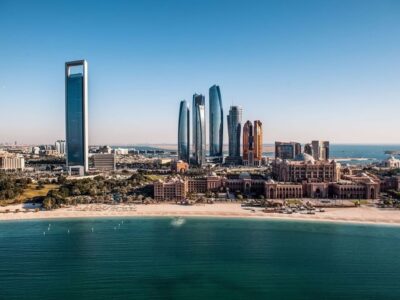


The UAE will host next week a first-of-its-kind global Climate tech forum, expected to be attended by more than 1000 leading global policymakers, CEOs, experts, technology leaders and investors.
The forum is to discuss practical actions to reduce emissions in the energy and hard-to-abate sectors by at least 43 percent by 2030, in line with the recent report from the Intergovernmental Panel on Climate Change (IPCC).
Other topics to be discussed include the role of technology in addressing the energy trilemma, availability, affordability, and sustainability and commercial incentives for decarbonization, new energies, and the impact of digitalization across industrial industry.
Global biggies such as AWS, Bank of America, 44.01 and Total Energies, along with technology pioneers including Carbon Clean, LanzaTech, and Bloom Energy will be among the participants at the forum, slated to be held on May 10-11 at Abu Dhabi.
The forum is organised by the UAE Ministry of Industry and Advanced Technology (MoIAT), in partnership with ADNOC and Abu Dhabi Future Energy Company (Masdar).
It is held in alignment with the UAE Year of Sustainability.
An exhibition and technical conference will also be held at the forum to showcase the latest advances in robotics, artificial intelligence, decarbonization, and energy transition fuels.
Dr. Sultan Al Jaber, Minister of Industry and Advanced Technology, COP28 President-Designate and Chairman of Masdar, said: “Meeting the goals of the Paris Agreement will only be achieved through urgent action and global cross-sectoral collaboration. I, therefore, call upon all industrial partners to attend this important forum and to engage with all relevant parties.”
He said the forum will play a pivotal role in navigating a common course towards concrete climate action, while enabling social-economic growth in support of transformation, decarbonization and future-proofing towards net zero.
The UAE is a significant investor in climate action, with companies such as Masdar targeting 100 gigawatts (GW) of renewables generation capacity and 1 million tons of green hydrogen production by 2030, while ADNOC has allocated $15 billion towards low-carbon solutions, new energies, and decarbonization technologies.
Follow us on

