



Engineer Bill Baker and designer George Efstathiou, of design firm Skidmore, Owings and Merrill, have worked on five of the world’s ten tallest buildings. But that didn‘t prepare them for the Burj Dubai.
Bill Baker, structural engineer on the Burj Dubai, is a perfectionist. So much so that he is one of the few people to have walked the entire length of the world’s tallest tower.
“Being an engineer I wanted to inspect everything,” Baker says of his trek down the tower’s more than 160 floors.
As impressively, he scaled the stairway in a mere 45 minutes; but then the Burj Dubai has always been about breaking records.
Baker and his colleagues met up with Emaar Properties in New York in March 2003 when a competition was held to create Dubai’s latest icon.
“Our first competition schemes were actually kind of dorky but it became much more elegant as the design progressed,” he says.
At the beginning the brief was simple: pitch the world’s tallest building. Baker, who is a partner at Skidmore, Owings and Merrill, the Chicago architectural and design firm which has worked on five of the ten tallest buildings in the world, had a rather conservative approach at first.
“The brief originally was to have it 10m taller. We didn’t want to promise more than we could deliver,” he recalls.
At the time, the world record was held by the 452m tall Petronas Towers in Kuala Lumpur, which was overtaken in 2004 by the 509m Taipei 101 in Taiwan.
“The first set of data [from the wind tunnel] was not good,” says Baker, “we went back and reshaped the tower. Then the client wanted to do it taller and the programme changed.”
Baker began to get more adventurous. He and the team decided that if they were going to go for the world record, they were going to do it Dubai-style. And that means the biggest and the best.
By the time the design was finished it was nearly as big as Chicago’s Sears Tower and New York’s Empire State Building put together – and over two and half times the size of the Burj Al Arab, Dubai’s other iconic rival.
“It is monumental,” Baker says. “It is roughly 1,000ft taller than the nearest competitor, which is a huge step forward.”
The bottom of the tower was made using 250,000 cubic metres of concrete, the equivalent to the weight of 110,000 elephants. The 35,700 metric tonnes of steel used in the top spire could stretch a quarter of the way around the globe if stretched end to end.
There have been rumours on the Dubai grapevine that the steel spire has a hydraulic system built into it so that it can be hiked higher, should another tower dares to challenge its world record.
Baker laughs, but refuses to confirm or deny the theories.
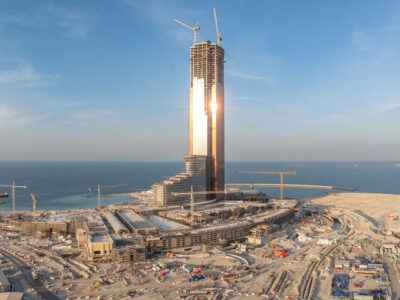
Construction began in spring 2005 and the tower was topped out in January 2008. “It went up very quickly. It went up like a vertical factory,” Baker says enthusiastically.The biggest challenge for the construction team was the fact that they were working in unchartered territory, he adds.
“A lot of times you have a height limit and you design up to that and you do the best you can. Here it was like we were going where no one had gone before and we weren’t sure how far we would get [and] we didn’t know the answer when we started,” he says. “That was quite a challenge.”
The sheer height of the building meant that many standard rules had to be rewritten, making innovation the name of the game.
Take the Burj Dubai elevators. These cabs will shoot visitors to the top at 25mph, reaching the tower’s peak in around two minutes. The elevators are, of course, the fastest and longest in the world – but they also have a third claim. The system is the world’s first to still be accessible in an emergency evacuation.
Cameras and other equipment have been installed in specific elevator shafts, enabling fire marshals to inspect the route. If the lift’s path is deemed safe, it can be used by residents to escape. The cabs have been christened “lifeboat elevators” says Baker.
At more than 800m high, his claim that the Burj Dubai boasts its own climate is almost believable. Dubai is notoriously oppressive during the summer months – is the tower really tall enough to escape the heat? According to Baker, the answer is yes.
“At the ground it is oppressive but by the time you get to the top it’s pleasant. I remember going up there when there was a nice gentle breeze and the air was very fresh.”
The tower’s designers were quick to incorporate this fact into the building, creating a system called ‘sky source cooling’. In short, the device sucks in air at the top of the tower, and circulates it around the building, cutting down on cooling requirements.
A ‘condensate collection system’ gathers the condensation beads that will collect on the tower; a system that is expected to generate some 15 million gallons of water a year, that will be used to water the tower’s plants.
Overall, it is a breakthrough in microdesign – these are features that will be incorporated in the superstructures of the future.
On a clear day, the Burj Dubai’s spire can be seen up to 95km away. But George Efstathiou, designer and manager of the project, believes the tower’s fame reaches far further.
“I’ve worked on other projects equal in size in terms of square footage and complexity but nothing this high that has gained so much attention on the world stage,” he says.
The tower was commissioned in the heart of Dubai’s building boom and, despite the impact from the downturn on the emirate’s property market, work continued unabated.
“The one thing that stands out in my mind is the high level of quality that has gone into the tower from Emaar,” Efstathiou says. “[It] was totally committed to this project all the time and their commitment never waned.”
As a leading design firm, SOM has a portfolio to envy. Yet, Efstathiou and Baker believe the Burj will be their crowning legacy.
“The reception has been uniformly positive,” Baker says. “Everyone likes the building and it is very exciting the fact that it actually got built.”
Says Efstathiou; “There is no question it has been a project that has been a career’s lifetime [achievement] and it has been a great excitement from day one.”
Follow us on

