



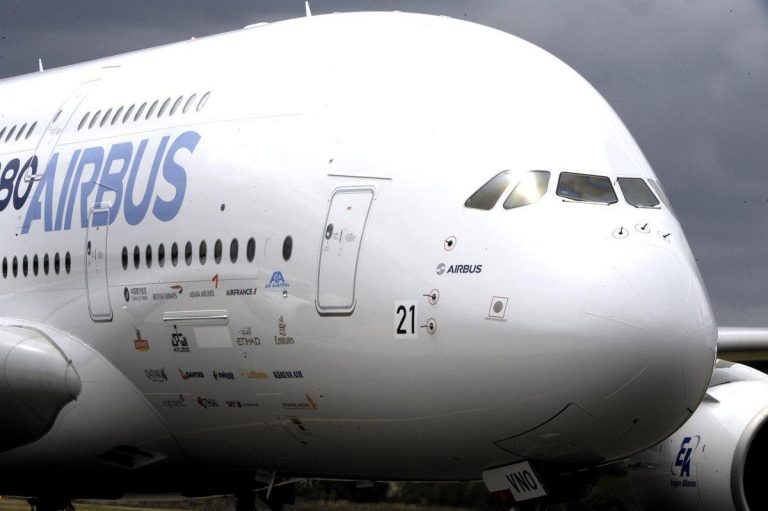
Airbus on Friday insisted its A380 superjumbo is safe to fly after another set of cracks was discovered in the wings of the world’s largest jetliner.
Some Asian airlines said they would develop inspection programmes while Emirates Airline said it was closely monitoring its fleet of superjumbos.
An Airbus spokeswoman declined to name the operator of the aircraft in which the latest cracks were found.
Two industry sources, asking not to be identified, said the latest discovery involved aircraft operated by Dubai’s Emirates. The airline did not comment on the Airbus disclosure.
An Emirates spokesperson said the airline was awaiting an update from European Aviation Safety Agency (EASA) regarding cracks found several weeks ago in A380s of other airlines.
“We continue to closely monitor our A380 fleet,” the spokesperson said in comments published by Reuters.
“The aircraft remain fully airworthy and pose no risk to flight safety as affirmed by EASA and the aircraft manufacturer, Airbus. The safety of our passengers and crew is our highest priority.”
Emirates is the largest A380 operator in the world and has carried more than 7 million passengers since the superjumbo was introduced to its fleet in August 2008.
It is the second time in as many weeks that hairline cracks have surfaced inside the mammoth double-decker jet, which entered service four years ago, and their discovery is expected to lead to expanded safety checks.
Airbus said the cracks were found on a number of “non-critical” brackets inside the wings of two aircraft during routine two-year inspections, after similar flaws showed up in five aircraft in early January.
It said the cracks did not prevent the A380 flying safely, but the Australian engineering body which handles routine servicing and engine checks on the superjumbos operated by Qantas Airways said Airbus’s reaction was concerning.
“They (Airbus) have described these as tiny cracks, but every crack starts off as a tiny crack and they can grow very quickly,” said Stephen Purvinas, Federal Secretary of the Australian Licensed Aircraft Engineers Association.
“I would be worried that Airbus aren’t taking seriously the ever increasing number of cracks being found in the wings of their A380 aircraft. Put it this way, I wouldn’t put my family on an A380 at the moment,” he said.
Qantas said the latest cracks were not found in its fleet of 12 A380s.
Airbus has dismissed calls to ground its superjumbo fleet over the cracks, which first came to light during repairs of a Qantas A380 damaged by an engine blowout shortly after taking off from Singapore in November 2010.
“It is embarrassing, but we will do everything to ensure safety is not compromised,” Chief Executive Tom Enders said.
“We have a pretty good understanding, but the investigation is ongoing. What we have developed already is a repair solution and this is what we will apply on the various aircraft if and where it is necessary,” he told CNN television.
Earlier this month, Singapore Airlines Ltd and Australia’s Qantas said they found some cracks in A380 wings.
On Friday, Qantas said it was developing an inspection programme in consultation with Airbus, and Singapore Airlines said it was starting inspections on one aircraft. It was unclear how many of its 15 A380 in operation would undergo checks.
“We are liaising closely with Airbus and will be carrying out precautionary inspections as required,” Singapore Airlines said in an emailed statement.
Korean Air Line Co said its five superjumbos did not have any cracks, but it would carry out close-up examinations earlier than Airbus had recommended.
China Southern Airlines Co Ltd said its two A380s would be flying the Beijing-Guangzhou route during the Chinese New Year holidays next week, a peak travel period.
Other operators of A380s include Air France and Germany’s Lufthansa.
Two aviation industry officials said European safety inspectors would order additional safety inspections.
A spokesman for the European Aviation Safety Agency confirmed it would issue an airworthiness directive on Friday.
Its US counterpart, the Federal Aviation Administration, said in a statement that its engineers are working with European authorities on a long-term fix for the cracking problem.
No US airlines operate A380s but they do fly to some US airports, including in Los Angeles, New York and Washington.
The latest problems were discovered in the same type of part as the earlier set of cracks – an L-shaped bracket that connects the wing’s exterior to the internal “rib” structure.
However, the appearance and location of the latest set of cracks were different. Two out of nine aircraft tested were found to have the newer cracks in the centre part of the wing.
Officials said the cracks most likely stemmed from a manufacturing process that put too much stress on the brackets, known as rib feet. The parts themselves were not flawed, according to specialist journal Air Transport Intelligence.
Aviation experts say the presence of tiny cracks is more risky near the root of the wing where loads are at their peak and least risky at the tip where the wing does least work.
Designers say modern aircraft allow loads to be carried by a different part of the structure when one part fails and most cracking is usually captured early without generating publicity.
“I don’t think people necessarily need to be worried about cracks because they are caught in advance and repaired,” said Snorri Gudmondsson, assistant professor of aerospace engineering at Embry-Riddle Aeronautical University in Daytona Beach, Florida.
“If the rib feet failed, the load would be transferred to other structural parts. These would eventually develop cracks themselves and increase the chances they would be discovered.”
Despite being billed as Europe’s “21st century flagship,” the iconic A380 has already had a bumpy ride due to development problems and the Qantas blowout, and Toulouse-based Airbus is anxious to prevent any further damage to its image.
The A380 – developed at an estimated cost of 12bn euros in Britain, France, Germany and Spain and sold at a catalogue price of $390m – has room on its wings to park 70 cars and a wingspan of 79.8m (261ft 10in).
Airbus, the planemaking subsidiary of EADS, has so far delivered 68 superjumbos, starting with Singapore Airlines which took the first aircraft in December 2007. It was followed by Emirates and Qantas.
South Korea’s Asiana Airlines Inc, which plans to induct six A380s between 2014 and 2017, said it was not changing that schedule as yet, but there was a possibility to reconsider if “profound cases” were found for the cracks.
* With Reuters
Follow us on

