




“This could be a really long conversation, because it’s something I’m really passionate about.”
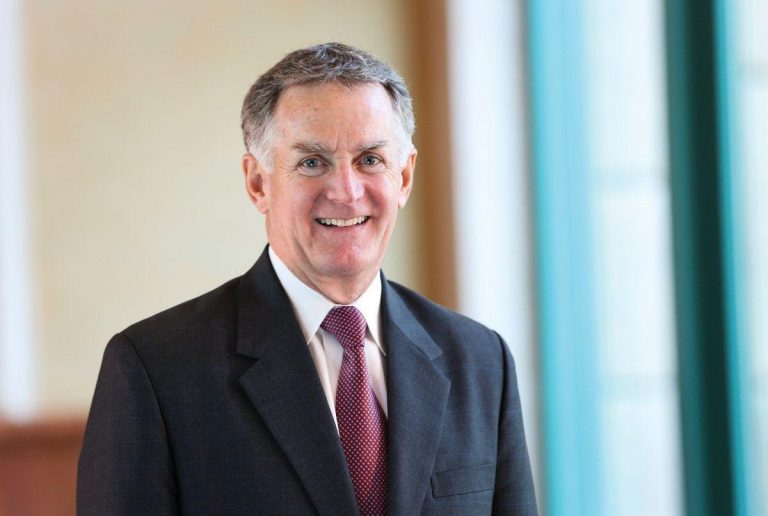
John Veihmeyer, global chairman of KPMG International, breaks away mid-sentence in a discussion about female CEOs, and how more can follow in the footsteps of Lynne Doughtie, who was elected to the prestigious role of US chairman and CEO at KPMG in April this year.
In doing so, she became the first woman to run the US operations of the global accounting firm, which had combined revenues totalling $24.8bn for the fiscal year ending September 2014.
While Deloitte was the first of the so-called ‘big four’ accounting firms (the others being PwC and EY) to appoint a female CEO — Cathy Engelbert — a matter of months earlier, it marks a move towards a more inclusive business leadership.
McKinsey research has shown that across the world, women make up only 24 percent of senior business roles, 17 percent of board positions, and 12 percent of CEOs.
When it comes to female board members in the Middle East, research firm Catalyst — which promotes inclusive workplaces for women — shows the figures drop quite dramatically. Oman has 1.8 percent; Kuwait, 1.7 percent; Bahrain, 1.7 percent; the UAE, 1.2 percent; Qatar 0.3 percent; and Saudi Arabia, 0.1 percent.
Veihmeyer says the process of appointing more female leaders should be a company priority.
“It’s a very top of mind issue for us as a firm. For me, personally, it’s all about talent. If we’re going to be the best firm in the world, we’ve got to have the best talent and we’re not going to have the best talent if we don’t have an inclusive culture where everybody feels like they can succeed,” he points out, speaking in Dubai’s Atlantis The Palm Hotel, where KPMG held a conference for its partners in the region.
In order to bring about the change, and have more women break through that glass ceiling, into senior positions, Veihmeyer says a company’s executive should identify potential leaders early on.
“If you really want more women leaders in organisations, you need the current leaders feeling like they’re willing to sponsor specific females to have the opportunities that will enable them to advocate for them, that there are roles available. As decisions are being made, [for example] about who to put in what positions two levels down from senior leadership, if women aren’t getting those roles they’re not going to get the experience they need to ultimately [move up],” he says.
“The reason Lynne [Doughtie] is in a position to be chosen as the best person available to be CEO of KPMG in the US is because ten years ago someone took a chance on Lynne and put her in a role that gave her exposure, allowed her to build that kind of experience. She did tremendously well and proved herself,” Veihmeyer adds.
When he says ‘took a chance’, Veihmeyer explains that he means it is about reaching into the organisation for young, potential leaders, no matter their gender.
“Part of the problem we, like many organisations, have is building a pipeline. So when I say ‘take a chance’, you have a choice to… go with the mid-50s male who has proven himself by virtue of roles he has been in, [but] if you stay on that strategy it’s going to be very difficult to build a pipeline of potential future women leaders,” he says.
The KPMG conference in Dubai on 1 October brought together 400 or so partners from the Europe, Middle East and Africa (EMEA) region, in an annual get-together. The attendees talked about the challenges in what is a very large region, Veihmeyer says.
Some of the discussion alluded to the company’s recent survey of 1,200 CEOs from businesses around the world, which concluded that the majority (62 percent) of business leaders are feeling more confident about the prospects for their company and the economy than they did a year ago.
“The one thing that was relatively interesting in the survey was that the results, for the most part, didn’t vary significantly, [such as] the themes of what was on [their] mind, where are the challenges and opportunities… it was actually interesting how much consistency there was, no matter what region you are talking about, including the optimism about where you expected your company to be headed over the next three years,” he says.
Veihmeyer says CEOs consistently spoke about the challenges, opportunities and impact of technology, as well as the need to transform business and “trying to get closer to your customer in a world where there’s new competitors springing up every day”.
But the was at least one significant variant — how highly geopolitical risk was rated. “There you saw some regional differences and obviously I think that’s a concern here in this region,” he says.
Another factor was the price of oil, which has been a standout topic for CEOs in the region in recent months.
“I don’t think anybody I’m talking to expects that in the next 12 months we’re going to see a significant change out of this $40-$60 range,” Veihmeyer says.
“It’s anybody’s guess as to how long it takes for the prices to recover more substantially, although I will say I’m not talking to too many people who believe any time in any kind of near-term scenario do we envisage getting back to where the prices were a couple of years ago. They’re talking about more normalised pricing, but it’s not a return to the pricing that we may have experienced up until the last couple of years.”
With family-owned mid-market companies representing half of KPMG’s global business, Veihmeyer says succession planning “is a huge issue”.
“It’s probably the issue that causes more of the M&A [mergers and acquisitions] opportunities that we see in this market than anything else, as companies get to a point where the founder doesn’t feel like he has an option to pass it on in the family, and needs an exit strategy,” he says.
“I think that’s where you’re seeing private equity move aggressively into regions that they hadn’t been active in before. You look at the expansion of private equity into India and markets like that, and I think it’s largely tied to this family-owned business kind of phenomenon.”
Veihmeyer says every business in almost every sector faces challenges in ambitions to expand outside their home markets. For family businesses, that can sometimes present a different challenge.
“I think sometimes family businesses are more challenged than others in terms of where the capital is going to come from to finance that kind of expansion, and where the management talent is going to come from in businesses where they have relied heavily on the family managing and operating.”
Technology, identified in the survey as a challenge for CEOs, is something that KPMG has embraced. More than halfway through a $1bn global investment programme aimed at developing new data and analytics solutions for clients, Veihmeyer says the company has made a number of acquisitions to develop products and solutions that he says will help grow KPMG’s operations and develop a much broader array of skills that traditionally hasn’t been the norm in a big four firm.
“Part of it is going towards acquiring companies or talent in skill sets that aren’t traditional for the big four firms,” he says. “And then a lot of it is just the development we’re doing internally or with alliance partners like Microsoft, which we announced this past summer, to invest very heavily in those technology-enabled tools.”
The return on the sizeable investment, he says, will come through maintaining its position as one of the top four, while it will also help develop new market areas.
“That billion-dollar investment is actually going to support our core business and ensure that it remains leading edge, which we have to if we’re going to remain strong in that core business. Also, it’s helping us expand our capabilities into new market areas and will be an accelerator of new growth for us.”
One aspect that wasn’t mentioned in the survey, but which has become quite a high-profile topic for CEOs, is corporate corruption.
Volkswagen, which developed engine software designed to fool regulators testing for diesel engine emissions, has been the most recent high profile case, while earlier this year, numerous senior FIFA officials were arrested on corruption charges.
Veihmeyer, who admits that it’s an issue that remains a challenge, says he’s involved in a World Economic Forum group that is looking at ways to “reduce corruption in certain jurisdictions”.
“Some of it is at the sovereign state level and obviously you see reforms in countries like China and India, where there are concerted state-sponsored efforts to try and get at the root cause of some of the historical corruption that has occurred,” Veihmeyer says.
At the individual company level, he says a lot of KPMG’s consulting work is aimed at enterprise risk, governance, controls, and areas that are most likely to increase the potential for fraud or corruption.
“It’s something that we’re concerned about and we pay a lot of attention to. We have all kinds of processes in place to try and make sure that we are, as a firm, very selective of the companies that we choose to work with and choose to associate our brand with, largely for those reasons. We need to continue to innovate [and] focus on quality to make sure that the audits that we are performing meet the expectation in the marketplace from that standpoint, as well,” he says.
As auditors for football’s global governing body FIFA since 1999, KPMG has launched an internal review of its Swiss business’ handling of FIFA’s financial record keeping following several state-led investigations. While the US Department of Justice’s charges againt 14 former FIFA executives and associates are primarily focused on racketeering , wire fraud
and money laundering — activities unrelated to any work that KPMG may have done — Veihmeyer says the review is part of its normal processes.
“Any time we have a situation where we have got a client involved in an issue, we always come in, review and take a look and see what, if any, learnings come out of that. So that’s what we’re doing in this situation, as well,” he says.
“I think it’s important to note that in terms of the issues that are being widely reported and the areas of concern with respect to FIFA, [they] are not issues that are actually embedded in the company’s system of financial controls that drive the financial statements. We report on the audited financials of FIFA and the individual country football programmes select their own auditors.
“We are not the auditor in the vast majority of those country programmes and frankly the activities subject to most of the governmental investigations at this point are not matters that would affect the company’s financial statements,” he adds.
Audit remains the largest of the three core parts of KPMG’s business, with advisory typically the second largest and tax being “somewhere like 15 to 20 percent of total revenues”.
“Audit is more of a stable growth, it’s going to grow 4 to 6 percent, hopefully, in a good market, year-over-year,” he says. “Our advisory business is growing 15 to 20 percent in many markets, including [in the Middle East]. They are very different growth trajectories but we have a very strong audit business here and that still remains our largest,” he adds.
The Middle East is where he expects KPMG’s growth to be at its highest globally.
“We view this as a high-growth opportunity for us,” Veihmeyer says. “We’ve been growing double digits historically in this region and we believe that can continue in the future. We expect this to be, from a percentage growth standpoint, one of our faster growing regions anywhere in the world. It’s a high priority for us.”
Follow us on

