


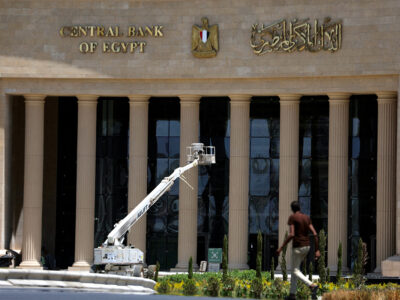


A senior banking official has warned of “a catastrophe” if sanctions are imposed on Lebanon’s Central Bank, as US media reports suggested hard-line measures are looming.
A report in the Wall Street Journal claimed that the United States is considering imposing sanctions on the central bank in light of money laundering, corruption and links to Hezbollah by top Lebanese officials.
The report comes as Washington and its allies have for months demanded a forensic audit of the central bank, a plan that suffered a setback earlier this month when the US-based independent auditor hired to carry it out withdrew, citing insufficient access to records.
“Today they thwarted the criminal audit,” caretaker Prime Minister Hassan Diab said after the finance ministry announced on November 20 that the New York-based firm Alvarez & Marsal had withdrawn.
A prominent banking official, who spoke anonymously to Arabian Business because of the sensitivity of the matter, said: “Imposing sanctions on the central bank threatens to destroy Lebanon’s economic structure and completely isolate Lebanon from the global financial system”.
He added: “When a newspaper like the Wall Street Journal publishes a report entitled Lebanon’s Central Bank Fuels Corruption, Extremism Concerns, this is an indication that American pressure on Lebanon is heading towards more hard-line measures.”
The official expressed grave concern, saying: “The extent of the damage that will befall Lebanon as a result of applying these sanctions against the central bank is beyond imagination. I therefore hope that the situation will be remedied before the worst happens, otherwise we are heading for catastrophe in every sense of the word.”
According to the WSJ report, current and former Western officials believe that influential people in political and economic spheres in Lebanon have so far obstructed international efforts to subject the central bank, known as the Banque du Liban, to a top-to-bottom review.
During a trip to Beirut in August, US Under Secretary of State for Political Affairs. David Hale, outlined US concerns.
The officials told the paper that weak central bank supervision has helped foster the widespread corruption that has been cited in a series of US sanctions.
Without a full audit of the central bank, they claim, the full extent of Lebanon’s financial problems can’t be assessed, including whether the central bank has any foreign currency reserves left to keep a collapsing currency from sparking hyperinflation.
Follow us on

