




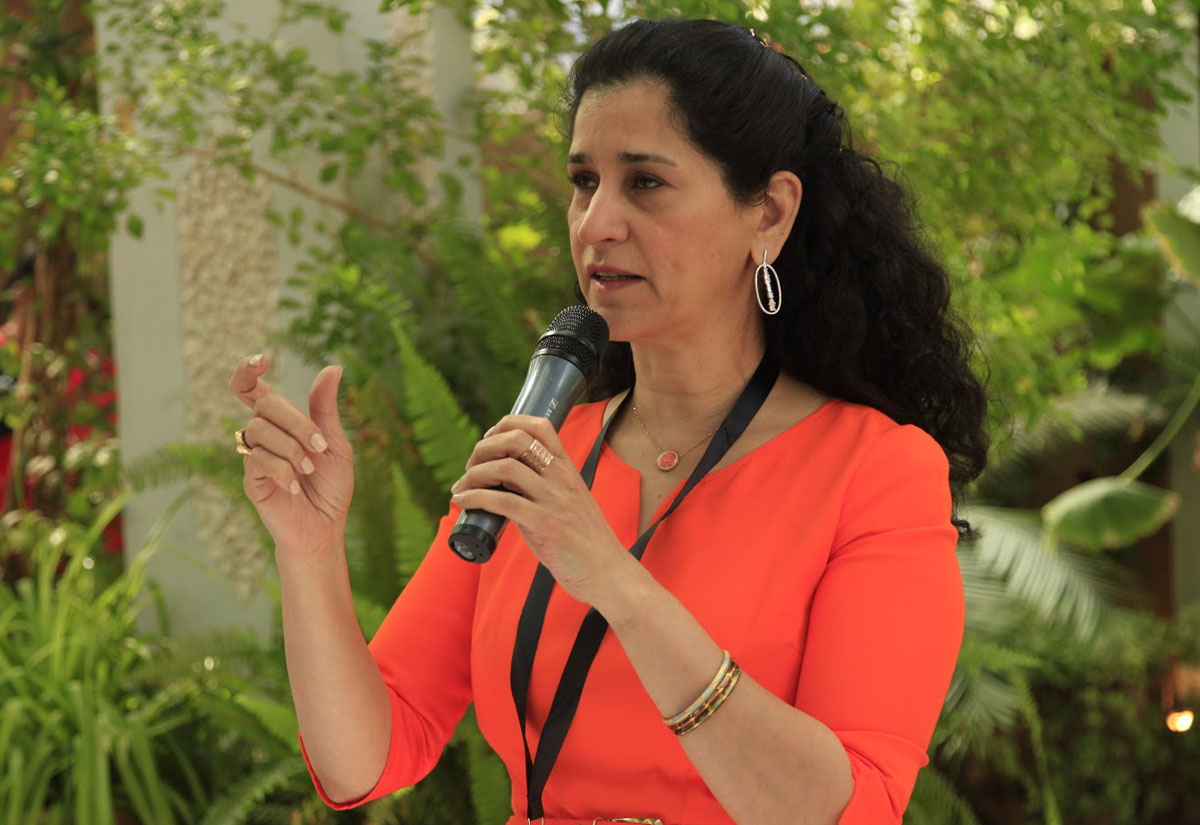
Sheikha Intisar AlSabah is a Kuwaiti philanthropist, entrepreneur, author, film producer, columnist and a princess of the ruling family of Kuwait – and so she would probably be the last person you would think of to suffer from ‘imposter syndrome’.
The work of her NGOs on applying the principles of positive psychology to guide positive change processes at human, interpersonal and organisational level has been accepted by the Kuwaiti Government, while earlier this year she presented their insights and achievements to the 74th session of the United Nations General Assembly.
However, she admitted her first steps into the business world were filled with more than a little trepidation.
She told Arabian Business: “In the beginning I thought it was so strange. I wasn’t used to it. I used to wear really high heels so I could see the men eye-to-eye.
“I don’t think it was an inferiority, it was more like imposter syndrome. There I am coming from no background in the corporate world, suddenly in the place where I’m running the business. If I take it from where I knew, I knew more about what the business was than these men, because I read everything. I wouldn’t leave a paper unread.”

To be fair, that feeling of ‘imposter syndrome’ didn’t last long and Sheikha Intisar helped transform the business, which, before her appointment, was reliant on loans and overdrafts. By the time she left to pursue other opportunities, she said: “We had cash in the bank, we had a new factory, we had two generations of new equipment.”
Her next move saw her launch Lulua Publishing, a media house based in Kuwait with publications including Good Health Arabia and Vacations & Travel Arabia. Again, empowering Arab women was at the forefront of her decision-making.
She explained: “We’re all about empowering women and what we realised is that the Arabic magazines at the time were very disempowering. They were all about gossip and horoscopes, beauty – beauty and fashion is good, but I thought and I still think, our Gulf women are very educated. We have engineers and doctors, we have highly educated women, why do we limit to them in fashion, beauty and gossip.
“I thought that was unfair. Then I realised, all publishing houses were run by men. Our publishing house actually changed magazines because we didn’t sexualise women, we made them look sensual and beautiful, but also wholesome.”
Since 2013, Sheikha Intisar’s two non-profits – Alnowair and Bareec – have been developing national programmes that use positive psychology to help bring about positive social behavioural change among young people in Kuwait.
Arguably, however, she is most known for her Intisar Foundation, a humanitarian organisation registered with the Charity Commission for England and Wales, and the first charitable organisation to provide psychological support programmes of drama therapy to Arab women impacted by the brutality of war.
Furthermore, she launched the One Million Arab Women initiative, a 30-year-plan to alleviate psychological trauma in one million Arab women affected by war.

She said: “I started the foundation when I realised there was no psychological support for women affected by war and I thought that was appalling, completely appalling. Once we started working on it, we set up a system where we’re using a different type of therapy, which is drama therapy because of the taboo and the hindrances to normal psychological support.
“We realised, with drama therapy, the women were expressing themselves in a different way; in a more courageous way. They learned to express themselves, to express their wants and to express their needs. But they also learned to role play, to sit in the other person’s shoes. With theatre it’s all about emotion and feeling, all about connecting, but it’s also about collaborating. Because we do it with groups, what they’ve realised is they are free to say what they want. They have more courage to ask for what they want and also having a support system allowed them to grow on the inside and find their self-worth, to find their value.
“Now these women have so much more value. We didn’t realise this, at the time we just wanted to support them and so once they realised they had this value, that they had all this courage and more self-esteem, this allowed them to stop the family abuse on them, and if not stop then really minimise it, and we’re talking about women who have been abused for 16 or so years, that have been able to stop it or reduce it drastically.”
Drama therapy, a melange between psychological therapy and theatre, is popular in the USA and the UK. Now Sheikha Intisar is looking to expand the operation and an MoU was recently signed with a Lebanese university to introduce drama therapy as a curriculum as a Master’s programme.
She said: “We’re going to have 300-600 drama therapists within the next 30 years. We want to transform the Arab world into a nation that speaks what they want, therefore they can find peace inside.”
Follow us on

