





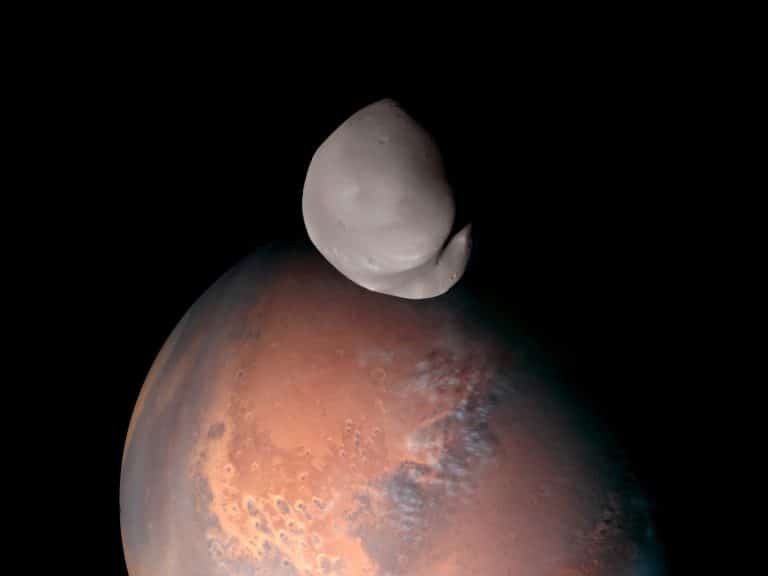
The UAE Mars mission has taken the most detailed photographs ever taken of the planet’s Deimos moon.
The stunning photographs were taken just 100km from the surface of the Mars moon by the UAE Space Agency and shared by Sheikh Mohammed bin Rashid Al Maktoum, Vice President and Prime Minister of the UAE and Ruler of Dubai.
UAE scientists took the stunning image from the Emirates Mars Mission’s Hope Probe
UAE Mars mission
Sheikh Mohammed took to social media to share the photograph, saying: “The Emirates Mars Mission’s Hope Probe has captured the clearest image of Mars’ moon Deimos, which is 100km away, marking a global first.
“Previously, theories suggested that Deimos was an outer asteroid captured in Martian orbit. However, the Hope Probe’s instruments and team have shown that the moon was once a part of Mars and separated from it millions of years ago, much like Earth’s moon.
“We are proud of our young scientists, science and our contribution to the march of human knowledge.”
The Emirates Mars Mission (EMM) is the first interplanetary exploration undertaken by an Arab nation.
It unveiled a series of unique and ground-breaking observations of the smaller Mars moon, Deimos, using all three of its science instruments to advance our fundamental understanding of the Red Planet’s most mysterious moon and its larger companion, Phobos.
The new observations challenge the longstanding theory that Mars’ moons are captured asteroids and instead point to a planetary origin.
The observations provide new insights into Deimos’ makeup and structure.
These include high resolution images taken during the closest repeated flybys of the moon, as well as the first ever observations made in the extreme and far ultraviolet and the first well-resolved hyperspectral data of Deimos in the thermal infrared.
The observations reveal, for the first time, regions on the far-side of Deimos which have never been compositionally investigated. The closest flybys saw Hope pass approximately 100km from Deimos.
“We are unsure of the origins of both Phobos and Deimos,” said Hessa Al Matroushi, EMM Science Lead.
“One long-standing theory is that they are captured asteroids, but there are unresolved questions about their composition. How exactly they came to be in their current orbits is also an active area of study, and so any new information we can gain on the two moons, especially the more rarely observed Deimos, has the potential to unlock new understanding of Mars’ satellites.
“Our close observations of Deimos so far point to a planetary origin rather than reflecting the composition of a type D asteroid as has been postulated.”
“Much like data acquired of Phobos indicate its composition is not consistent with a captured D-type asteroid, early results from EMIRS observations of Deimos tell a similar story.
“Both of these bodies have infrared properties more akin to a basaltic Mars than a D-type asteroid such as the Taggish Lake meteorite that is often used as an analog for the spectral properties of Phobos and Deimos,” said EMIRS Instrument Scientist Christopher Edwards.
Hope has so far made a number of close flybys of Deimos following its transition to a modified orbit using a process known as a ‘Lambert transfer’, a manoeuvre that subtly but consequentially altered Hope’s orbital trajectory to enable Deimos observations while maintaining the mission’s ability to create planet-wide observations of Mars’ atmospheric dynamics.
While both Mars moons were discovered via telescope in the 19th century, detailed study only became possible during the Space Age.
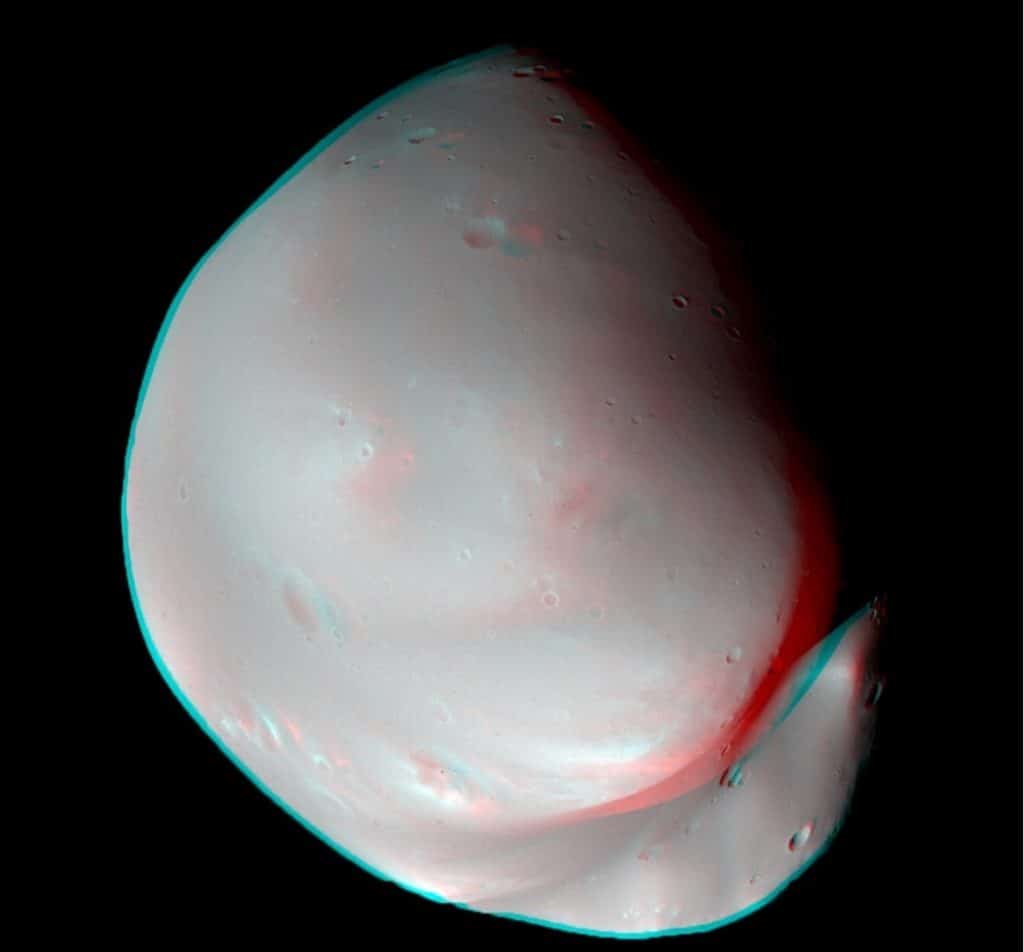
Deimos is the less observed and understood of the two moons, being smaller and orbiting in a wider orbit that completes every 30 hours.
The new findings come as the UAE Space Agency, responsible for the funding and operation of the Emirates Mars Mission, confirmed the extension of EMM’s mission for a further year.
“The remarkable performance of the Mars Hope probe has supported a whole range of new observations in addition to meeting our originally stated science mission goals,” said UAE Space Agency Chair Sarah Al Amiri.
“In the circumstances, Hope exceeding all expectations, we are extending the Emirates Mars Mission for a further year.”
Hope is currently orbiting the planetand completes one orbit of the planet every 55 hours and captures a full planetary data sample every nine days throughout its mission to map Mar’s atmospheric dynamics.
Follow us on

