





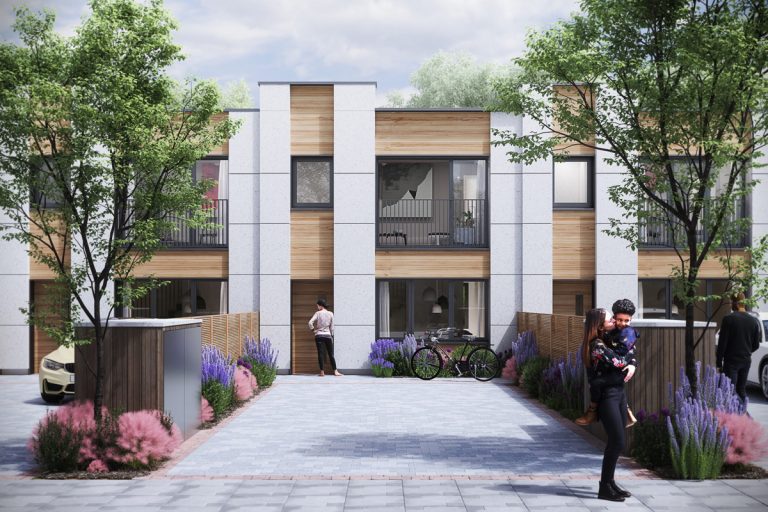
A new modular homes factory will bring around 350 jobs to Dubai once it is operating at full capacity, which is expected to take between two-and-a-half and five years, Gwyn Taylor, general manager at the newly formed Linq Modular, told Arabian Business.
Modular, or prefabricated, homes have risen in popularity as their production is more easily controlled, meaning environmental standards can be enforced and they are more likely to be completed on time – some 70 to 90 percent of construction projects don’t finish on time, pushing them over budget.
“Modular housing has the opportunity to be more repetitive, better controlled, better quality controlled, and not just to deliver on time, but to also improve delivery times overall, so stakeholders can get a better return on their investment,” Taylor said.
Modular homes are placed on a permanent foundation, but the structure is pre-built in sections that make it possible to take it apart, transport and build it at its destination. For Linq Modular, which claims Dubai-based Alec Engineering and Contracting as a parent company, they’ve eyed the UK where they’ve signed a partnership with a property developer.
In a world more attuned to growing climate concerns, modular housing is an attractive alternative. They’re greener to build, use less energy while occupied and are easier to recycle and deconstruct at the end of their lifecycle.
Linq Modular is compliant with their export market standards, and they are working to make their houses net zero emissions throughout their lifecycle.
“If we use renewable energy and we use renewable water sourcing, it’s possible to get the whole thing to net zero over its lifespan. It’s difficult, but it’s possible,” said Taylor.
Typical estimates of building materials wasted range from 10 to 30 percent on a construction site, but modular design is able to significantly lower that.
“We’ve targeted less than 3 percent physical waste that comes from our product and construction,” Taylor said.
 Gwyn Taylor, general manager at Linq Modular.
And where traditional homes can take four-to-six months to build, modular homes can take six to 10 weeks. “Our energy input, and our manpower and material use is much lower,” Taylor said.
Initially, Linq Modular will export to the UK, but they’re eyeing exports to Europe as well as providing housing for the domestic UAE market and Saudi Arabia.
In Dubai two-story modular homes are not yet approved, and the company is working with the government on the approval process.
“In Saudi, the volume of work set to be delivered is huge and the reality is there’s probably not enough contractors in the supply chain to get that done with the infrastructure they have,” he said.
The kingdom has launched multiple mega development projects across the country and has simultaneously worked hard to improve its ease of doing business ranking to attract foreign firms.
Follow us on

