




Dubai Metro is celebrating its 15th anniversary on Monday, September 9, marking a significant milestone in its journey of transforming the city’s mass urban transit.
The metro has become a vital lifeline connecting key areas across Dubai, providing reliable and sustainable transport for residents and visitors alike.
Since opening on September 9, 2009, the metro has grown to keep pace with the city’s rapid urbanisation, playing an important role in shaping it into a major global hub for business and tourism, and enhancing its status as a city of the future.
Dubai Metro anniversary
Over the past decade and a half, Dubai Metro has consistently grown in ridership, reaching approximately 2.4bn passengers.
The metro has been instrumental in meeting the demands of the city’s rising population and expansion, achieving remarkable success in operational efficiency, punctuality, and adherence to the highest global safety standards.
With an average daily ridership of approximately 730,000 passengers, the metro today is the preferred mode of transportation for numerous residents and visitors.
The metro maintains an impressive punctuality rate of 99.7 per cent, consistently surpassing its targets and upholding high safety standards and operational efficiency.
Since its establishment, Dubai Metro has facilitated 4.3 million journeys, encompassing 26.8m kilometres.
Mattar Al Tayer, Director General, Chairman of the Board of Executive Directors of the Roads and Transport Authority (RTA), ssaid: “The Dubai Metro is one of the visionary initiatives of His Highness Sheikh Mohammed bin Rashid Al Maktoum, Vice President and Prime Minister of the UAE and Ruler of Dubai.
“It aims to provide a world-class public transport infrastructure, positioning Dubai as a global hub for finance and business. The concept is anchored in His Highness’s firm belief in the importance of a metro system to meet the growing population and urban development needs of the city.
“His Highness envisioned the metro as the backbone of a transportation network that links all key areas in the emirate, ensuring safe and smooth travel for passengers. His Highness also directed that the metro’s facilities must have the highest standards of elegance and luxury”.

Since its inauguration on September 9th, 2009, the Dubai Metro has maintained a continuous track record of success. The metro network has expanded significantly, with the length of lines growing from 52km to 90 km, the number of stations increasing from 10 to 53, and the number of operating trains rising from 79 to 129.
Daily ridership also surged from 20,000 on September 10, 2009, to 767,000 on September 3, 2024.
On some days, such as New Year’s Eve and major holidays, the metro has accommodated up to 900,000 riders in a single day.
Furthermore, Dubai Metro has created job opportunities for Emirati nationals, with 228 citizens currently employed by the metro’s operating company.
Al Tayer added: “It has maintained its status as the world’s longest driverless metro project and a landmark project of the Roads and Transport Authority in Dubai, serving as the cornerstone of the emirate’s public transport system.
“It continues to uphold its global reputation for safety, adopting environmentally friendly and effective solutions, supporting green economy principles, and achieving operational efficiency and punctuality in service schedules”.

The trajectory of Dubai Metro ridership has shown continuous growth since the service launch.
- 2009: 6.089m (four months)
- 2010: 38.089m
- 2011: 69.001m
- 2012: 109.049m
- 2013: 137.076m
- 2014: 164.031m
- 2015: 178.065m
- 2016: 191.033m
- 2017: 200.075m
- 2018: 204.041m
- 2019: 202.098m
- 2020: 113.063m (start of COVID-19 pandemic)
- 2021: 151.026m
- 2022: 225.142m
- 2023: 260.034m
- 2024: 175.46m (Until end of August)
On June 2019, 2016, Sheikh Mohammed bin Rashid Al Maktoum approved the awarding of the Route 2020 project contract to extend the Dubai Metro’s Red Line from Jebel Ali Station to the Expo 2020 site.
Valued at AED10.6bn ($2.9bn), the contract was awarded to the Expo link Consortium, which includes French, Spanish, and Turkish companies.
On 5 September of the same year, Sheikh Hamdan bin Mohammed bin Rashid Al Maktoum laid the foundation stone for the Route 2020 project, marking the start of construction.

On July 8, 2020, Sheikh Mohammed bin Rashid Al Maktoum officially launched the Route 2020 line of the Dubai Metro.
Route 2020 spans 15km (11.8km above ground and 3.2km underground). It connects seven stations (one interchange station with the Red Line, a station at the Expo site, three elevated stations, and two underground stations).
It serves densely populated areas such as The Gardens, Discovery Gardens, Al Furjan, Jumeirah Golf Estates, and Dubai Investment Park, home to more than 270,000 residents. The journey from Dubai Marina to Expo Metro Station takes about 16 minutes.
The line has a capacity of 46,000 riders per hour in both directions.
In continuation of RTA’s efforts to develop the public transport network, on November 23, 2023, Sheikh Mohammed bin Rashid Al Maktoum approved the route of the Dubai Metro Blue Line, which will stretch 30km and connect 14 stations.
The line is designed to serve key areas with an expected population of about one million people, according to the Dubai 2040 Urban Master Plan.
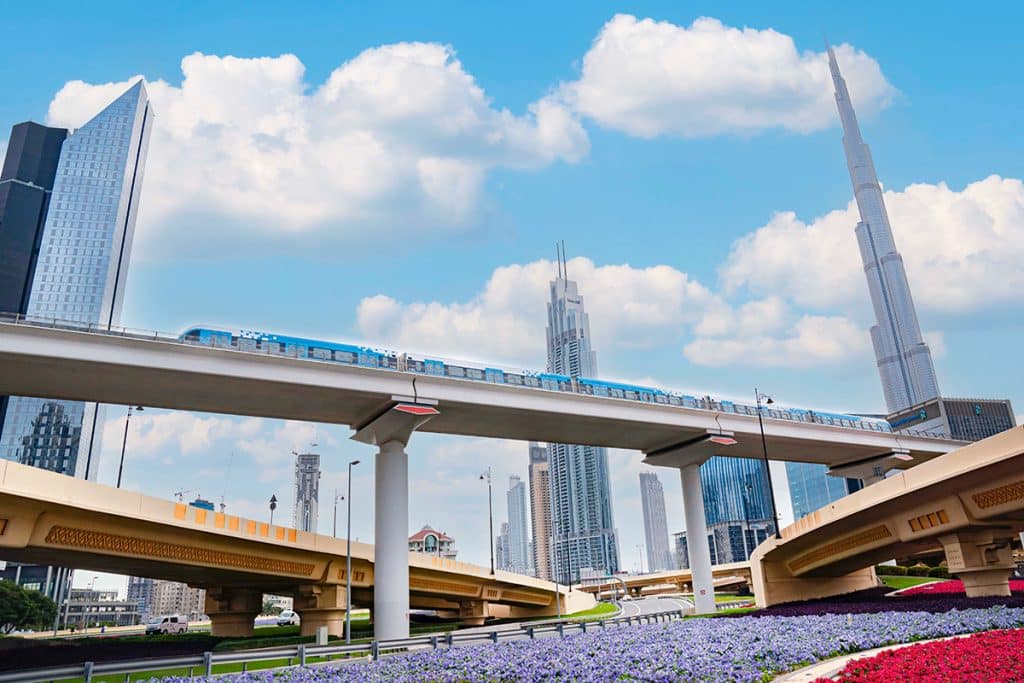
The Blue Line is the fifth strategic project in the portfolio of public transport projects, following the Red and Green Lines of the Dubai Metro, the Dubai Tram, and Route 2020.
It is also one of the largest strategic projects in the public transport industry, contributing to the Dubai Economic Agenda D33 and the objectives of the Dubai Urban Plan 2040 aimed at making Dubai the best city for living in the world and enhancing its global competitiveness as an attractive hub for international events.
The Blue Line will also enhance connectivity and integration with the Red and Green Lines of the Dubai Metro and provide direct links between Dubai International Airport and nine key areas along the route, with travel times expected to range between 10 and 25 minutes.
The Blue Line has several distinctive features, including the first Dubai Metro bridge to cross Dubai Creek, spanning 1,300 metres, and two iconic stations—one at Dubai Creek Harbour and the other at Dubai Silicon Oasis (the fifth urban centre).
Both stations boast unique architectural designs by the globally renowned firm Skidmore, Owings & Merrill (SOM).
Additionally, the line includes the largest underground transfer station in the metro network, covering over 44,000sq m, with a capacity of around 350,000 passengers per day.
It is also the first transport project compliant with platinum-grade green building specifications.
Follow us on

