



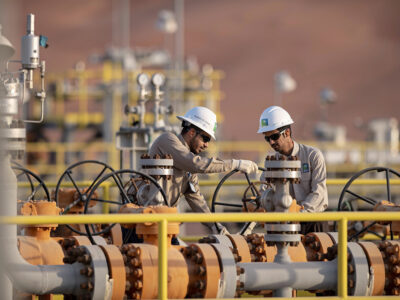
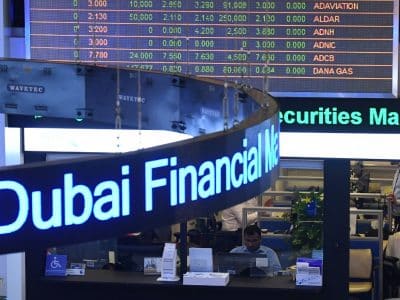

France is talking to the UAE about the supply of oil and diesel as it seeks alternatives to Russian energy sources, Finance Minister Bruno Le Maire said on Sunday.
France also planned to accelerate investment in the transition to cleaner energy, such as speeding up the roll-out of offshore wind farms, to increase the country’s independence, the minister outlined.
“We are looking for substitutes to the supply of gas or diesel from Russia,” Le Maire said during an interview with CNews TV and Europe1 radio.
“For example, the United Arab Emirates can be a solution, at least temporarily, to replace Russian oil and diesel. These are discussions that have already begun with the United Arab Emirates,” he added.
The European Union approved a sixth package of sanctions against Russia over the war in Ukraine last week that included a partial ban on Russian oil imports, to be cut to 92 percent by yearend, according to French President Emmanuel Macron. He also said an embargo on Russian gas must not be ruled out.

Thierry Breton, the EU’s internal market commissioner, said in a separate interview with CNews and Europe1 on Sunday that Russian leader Vladimir Putin was using gas in an effort to split Europe as he continues to wage war on Ukraine.
“We must also free ourselves from gas, because Russian gas today, we must get our autonomy back as quickly as possible as Vladimir Putin doesn’t like the European project,” Breton said. “For years, he’s done everything to divide Europe. Now he’s using gas precisely to divide us.”
Saudi Arabia raises selling prices for oil across Asia
This comes in as Saudi Arabia signalled confidence in demand with a bigger-than-expected price increase of its crude for Asia in July as China, the world’s top crude importer, cautiously emerges from virus lockdowns that have strained its economy. West Texas Intermediate traded near $120 a barrel after earlier rising to the highest level in almost three months.
Oil has rallied almost 60 percent this year as rebounding demand from economies recovering from the pandemic coincided with a tightening market after Russia’s invasion of Ukraine. The war has fanned inflation, driving up the cost of food to fuels and prompted aggressive monetary tightening from central banks.
OPEC+ last week agreed to accelerate output following repeated calls by the US to pump more. The cartel said it would add 648,000 barrels a day for July and August, about 50 percent more than the increases seen in recent months. However, the group has struggled recently to meet its supply targets, raising doubts about whether it would be able to meet the goal.
The fuel market has also tightened considerably, just as the peak period for US demand kicks off with the summer driving season. Retail gasoline prices have rallied to a record, while futures in New York hit a fresh high on Monday.
“The peak demand season is here,” said Chen Shuxian, an analyst with Cinda Securities Co. in Shanghai.
The summer driving period in the US and Europe will underpin higher consumption, while China’s demand will recover with the easing of virus restrictions, Chen added.
Saudi Aramco raised its key Arab Light crude grade for Asian customers by $2.10 a barrel from June to $6.50 above the benchmark it uses. The market was expecting a boost of $1.50, according to a Bloomberg survey. Aramco also increased its prices for northwest Europe and the Mediterranean regions.
Brent remains steeply backwardated, a bullish structure where near-dated contracts are more expensive than later-dated ones. The prompt time-spread for the global benchmark was $2.70 a barrel in backwardation, compared with $2.69 on Friday. For WTI, the spread was near $3.
Follow us on

