







In Dubai, a 15-month-old startup called LEAP71 achieved a significant milestone in aerospace engineering: successfully test-firing the world’s first liquid-fuel rocket engine designed entirely by artificial intelligence.
This groundbreaking achievement marks not only the first engine designed by AI – or computational engineering – but also the first liquid rocket engine created in the region.
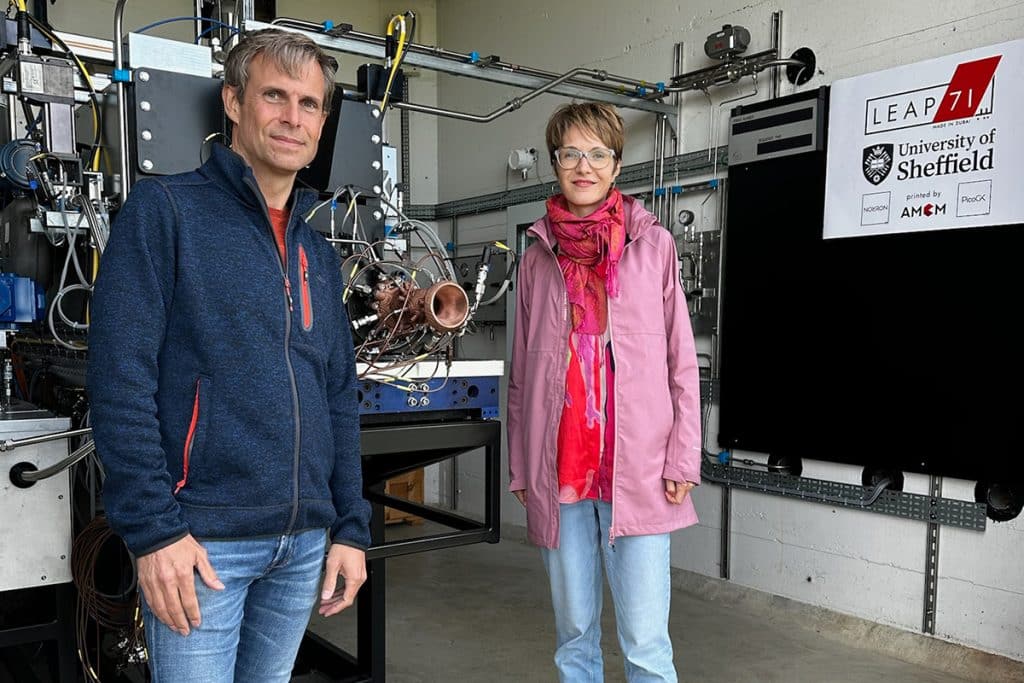
This behind-the-scenes look reveals the intense preparation, challenges, and implications behind the husband-wife duo’s groundbreaking experiment. Serial entrepreneur and engineer Lin Kayser and his wife Josefine Lissner, an aerospace engineer, combine their expertise as co-founders of LEAP71.
The countdown begins
Kayser recounts the tense 48 hours leading up to the test. “We were worried about a lot of things,” he said. “First of all, are our computational models correct? Are our thermal models correct?”
The team’s 5 kN thrust engine, made of copper, would face exhaust gases exceeding 3,500°C. “It’s not very hard to create literally a liquid engine, not a liquid fuel rocket engine, but a liquid engine,” Kayser explained, highlighting the risk of melting if their cooling system failed.
Logistical hurdles
The team faced shipping delays due to customs issues when transporting the engine, which was printed in Germany, to the UK test facility. Once there, it took six hours to wire up the engine and prepare it for testing.
The use of liquid oxygen as an oxidizer posed particular challenges.
“If you have pure oxygen, it combusts anything in its presence,” Kayser explained. This property made even the smallest contaminants potentially disastrous.
A critical moment arose when a team member used an air blower to clean the engine.
Another quickly pointed out the risk: “Do you know that the air blower is using a compressor that uses oil to pump the air? So now you have a tiny film of oil in the channel. If you run liquid oxygen through it, now it will immediately explode.”
This led to an inconvenient but necessary recleaning process.
The moment of truth
The test took place at a former UK Air Force facility from World War II, with the team in a bunker protected by three-metre-thick concrete walls.
Despite the engine’s small size, it was capable of generating 20,000 horsepower – enough to lift 500 kilograms off the ground.
The initial test was a short burst using conservative parameters.
To their relief, the engine performed as expected. Encouraged by this success, they proceeded with a full 12-second burn at nominal conditions.
The results exceeded projections, said Kayser. Not only did the engine perform flawlessly, but the cooling system also proved more effective than anticipated.
“We could have run it forever. So it was not damaged. It achieved a steady state,” he noted.
The extreme cold of the liquid oxygen propellant (minus 200°C) contributed to keeping the engine cooler than expected. “You turn off the ignition, and instantly freezes over… So this whole thing is immediately covered in ice, when just a second ago it was blasting fire and now it’s frozen.”

‘Playing catchup’ with Russia, China, US
Post-test analysis began immediately, with data fed back into their AI models. “Literally five minutes later, you can have a new rocket engine that you could print again.”
This rapid iteration capability is central to LEAP71’s approach to accelerating engineering innovation.
The company sees this technology as potentially levelling the playing field in the space industry.
“Everybody is playing catch up with the Americans, the Russians, and the Chinese,” Kayser said. “If you want to speed up, then you have to have a different approach to engineering.”
He emphasised the importance of this approach, given the historical context.
“The reason why companies like SpaceX could actually build rockets in a relatively small amount of time is because there’s this wealth of data from the 1950s, 60s, and 70,s – the golden age of rocketry,” he explained.
“Back then, they simply tested and tested and tested because they had an infinite budget. Today, you can’t do that anymore – the costs are prohibitive. Nobody has the budget that NASA had in the 1960s [so] you have to be smart about it and this is why using computational models is so important.”
The Dubai advantage and future plans
LEAP71 chose Dubai as its base, with Kayser praising the emirate’s focus on emerging technologies and business-friendly environment.
“For us, Dubai is almost like an oasis,” he said, contrasting it with the regulatory challenges in Europe.
“Whereas in Europe, you’re constantly busy attending all kinds of things that have nothing to do with your work… [there’s] lots of bureaucracy, regulations, and political issues. There’s always something going on that has nothing to do with your work.”
Looking ahead, LEAP71 hopes to conduct future tests in the UAE, though challenges remain in local manufacturing capabilities and testing facilities.
The company is also exploring applications beyond aerospace, including innovations in electric motors and air conditioning systems.
LEAP71 has open-sourced a significant portion of their technology stack, aiming to democratise access to these powerful engineering tools.
As they continue to refine their AI models and explore new applications, LEAP71’s recent success marks a significant step in their mission to accelerate engineering innovation in the space industry and beyond.
Follow us on

