



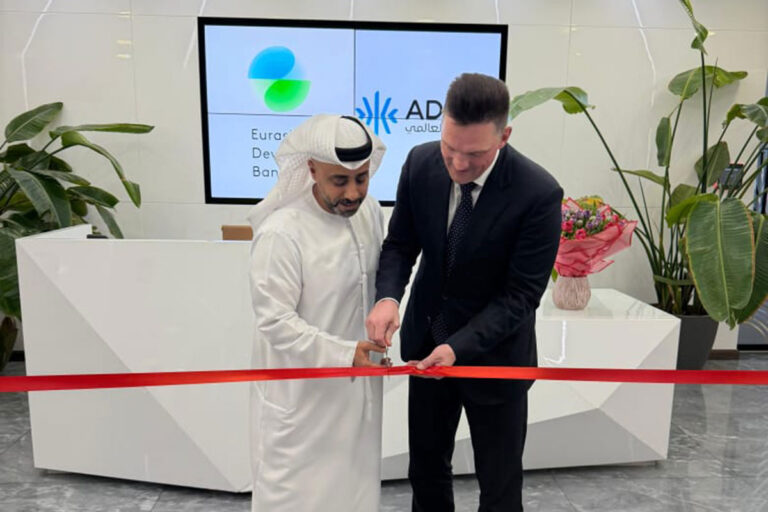
The Eurasian Development Bank (EDB) has established a major new investment bridge between the Gulf and Central Asia with the opening of its representative office in Abu Dhabi Global Market (ADGM).
The move forms part of a wider plan to create a dedicated platform that will allow Gulf Cooperation Council investors to access infrastructure and sustainable development projects across the Eurasian region.
The office was inaugurated in Abu Dhabi in the presence of Salem Al Darei, Chief Executive of ADGM Authority, and Nikolai Podguzov, Chairman of the EDB Management Board.
EDB expands footprint in Abu Dhabi
The new platform will offer GCC investors curated investment opportunities backed by the bank’s regional expertise, government relationships and project pipeline. Investors will be able to participate in the financing of transport corridors, renewable energy, water and agribusiness schemes and other strategic sectors.
Podguzov said the initiative will create an “investment highway” between the regions. He added: “Investors gain access to proven projects with an optimal risk-return profile, while Central Asian countries gain access to new sources of funding for their development.”
The EDB’s presence in ADGM is intended to strengthen its links with regulators, sovereign wealth funds and institutional investors in one of the world’s most active financial hubs. It will also support the development of new financing instruments, including Islamic finance products.
A key component of the platform will be a specialised credit fund registered in ADGM that will finance infrastructure projects across Central Asia. The fund will focus on debt instruments and offer a diversified portfolio in which the EDB acts as a structuring partner and co-investor. It is designed to attract regional and international investors seeking secure, transparent access to emerging market infrastructure.
Al Darei welcomed the decision, saying: “By establishing their platform within our robust regulatory ecosystem, the EDB will be better equipped to connect Gulf investors with high-quality opportunities across Central Asia.”
Bridging markets across Gulf and Asia
The expansion follows two successful dirham-denominated bond issuances by the bank earlier this year, signalling growing demand for EDB instruments among Middle Eastern investors.
Central Asia represents a fast-rising investment destination for the Gulf. Mutual trade with GCC states has increased more than fourfold over the past five years, while direct investment has nearly doubled. Significant opportunities exist in logistics, including the North-South Corridor, as well as in water management, agriculture and renewable energy.
The region is also emerging as a growth market for Islamic finance, which is forecast to reach more than US$11 billion in combined banking assets and sukuk outstanding by 2033.
The EDB, a multilateral institution focused on strengthening economic integration across Eurasia, has invested more than US$19 billion in 319 projects since its inception. Its current strategy prioritises transport networks, agricultural distribution systems and water and energy infrastructure across Central Asia.
Follow us on

