


Piling and foundation contractors in the region are waiting for the market to start looking up. CW chats to a couple of piling experts to get their thoughts on the matter.
Talk to anyone in the construction industry and they’ll tell you that ground works, including piling and foundation, is probably the most important task in building the average tower.
And as various sectors within the construction industry struggle to climb out of one of the worst economic downturns in recent history, piling and foundation contractors too, have not been spared and are hoping for a change to come along.
But with numerous contracts having recently been awarded in Abu Dhabi and Saudi Arabia, it appears that the situation could be improving gradually. One piling contractor thinks not.
“The market for piling and foundations has not improved at all since the middle of 2008,” complains Ras Al Khaimah-based Al Nuaimi Foundations & Concrete division manager Kochummini Mukundan. “And that is why we’re waiting in hope for the time when the market gets better.”
Shad Asif Khan, general manager for piling contractor Keller Grundbau, agrees with Mukundan over the current market situation and backs up his opinion with a simple fact.
“The number of piling rigs available in the market is still much more than the demand for them, because construction activity is still not as much as it was back in 2008,” he says.
So what can bring about this change? With the region now focusing heavily on sustainable construction and cheaper costs, could a change in techniques bring down the overheads?
An independent sustainability expert suggested a shift from concrete foundations to steel foundations could result in better Leed ratings, but it is still being researched.
“Concrete pile foundations are quite popular here in the market and we have enough additives to extend the life of the concrete,” says Mukundan.
He adds that in his 47 years of experience in construction, he has never known steel piles to be ‘that popular’ in the region.
Khan, however, weighs the pros and cons of steel and concrete in a little more detail. He says steel foundation installation can have a high production rate, but adds that when compared to concrete foundations the head treatment would be significantly reduced.
“Some additional measures such as cathodic protection or epoxy coating may be necessary to prevent corrosion but both options can fulfill sustainability requirements. The carbon footprint for steel would be much higher than concrete, but it can be more easily recycled then concrete piles,” he adds.
So when exactly are steel piles used since concrete seems to be the preferred option in the Middle East? And will steel piles ever fit into the scheme of things to come?
“Our company has worked successfully with both systems,” confirms Mukundan but says they’ve got their own uses.
“In general, steel foundations are mostly used for harbours and jetties. For marine construction, steel foundations have more advantages than concrete ones, but on land-based high rise buildings, it is more economical to build with concrete foundations,” he explains.
Finding work at the moment is not the easiest task, but has the piling and foundation sector improved over the last five years in terms of technology and has the equipment being used been upgraded?
While Mukundan reminisces about starting out in 1963, when everything was mostly mechanical and manual, Khan compares the more recent systems on the ground.
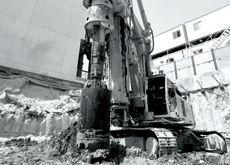
“The crane hung piling units are hardly used by any professional piling company; custom built pile drilling rigs are definitely more popular,” says Khan.
He feels that the practise of using bentonite to stabilise the collapsible part of a borehole is also slowly diminishing.
“Many incidents are being heard of, where well known names have had problems with piles settling more than expected, due to either reduced skin friction of pile walls or reduced end-bearing due to un-cleaned bentonite from the pile base,” he says.
“Previously for construction of secant pile walls also, companies were avoiding the use of full-cased holes for reinforced piles, but this practice is also reducing as the quality of a fully-cased pile is distinctly better than cutting unreinforced piles without casing,” he adds.
The reason why piling and foundations work is regarded as one of the most vital steps in the construction process, especially in the region, is due to the many different soil types, each country or city have.
This variety leads to many technical challenges which have to be paid careful attention to.
But Mukundan thinks the biggest challenge he has to face at the moment is on the commercial side. A very serious challenge in these times indeed! But Khan focuses on the technical aspects instead.
“The cavities in certain areas of Abu Dhabi pose a challenge to the piling contractors,” he says.
“[We have] to tackle them in a manner where the integrity of the pile remains intact. This challenge is overcome by shear experience and knowledge of the piling contractor,” he explains.
With Abu Dhabi announcing projects and awarding contracts every week, it has clearly become the preferred playground for the construction industry in the UAE. Similarly, Saudi Arabia is a counterpart on a regional scale.
Keller has a strong presence in Saudi Arabia and Abu Dhabi according to Khan and so do most other leading piling contractors.
“Our company has already registered in Saudi Arabia for our division as foundations and for all other activities in our group,” says Mukundan.
“We also have a presence in Oman as well as our home country, the UAE.”
Mukundan adds that Al Nuaimi Group is also currently looking for possible joint ventures and partnerships in various foundation projects across the Middle East.
1. Steel foundations good for marine construction like harbours and jetties
2. Concrete foundations are more economic for land-based construction
3. Concrete foundations last longer when additives are used
4. Steel foundations have a high production rate
5. Steel foundations head treatment significantly reduced
6. Both options are sustainable options
7. Carbon footprint of steel will be much higher than concrete
8. Steel piles can be easily recycled than concrete piles
Follow us on

