


As the Princess Tower gears up to become the tallest residential building in the world, Construction Week looks at the progress on the 420m-high development and discovers what makes building a tall tower different from any other project.There’s no place like Dubai Marina to find a room with a view. With The Palm Jumeirah on one side and the city’s bright lights on the other, it’s no wonder that UAE developers are making their mark in the scenic location by constructing super-tall residential buildings.
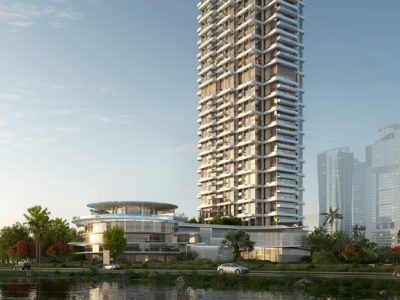
In fact, building the tallest has almost become a competition in the area with 23 Marina and the Elite Residence Towers reaching new heights and set to stand at 90- and 91-storeys respectively upon completion. But, it is the Marina’s Princess Tower that is set to reign as the tallest residential building in the world upon its expected completion date of July 8, 2011.
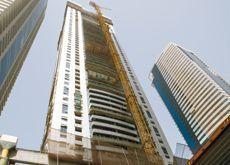
The project was first announced by Tameer Holding Investments in November 2006 and, three months later, Arabian Construction Company (ACC) was awarded the main construction contract. Work began immediately and the development, which will stand at 100 stories, has now reached the 58th floor.
The Princess Tower consists of approximately 580 apartments. It has gymnasiums and swimming pools on levels five and six, and has six floors of parking below ground and four above.
There will also be some retail outlets facing Al Sufouh road and the side street running back to the marina. In addition, there will be a recreational area at level 97 for owners of the building and guests to enjoy the surrounding sights.
“Already the floor at level 57 is spectacular. It overlooks The Palm and the rest of the marina,” says ACC project manager Bill Parker.
The tower is currently progressing five to six days ahead of the planned schedule but, according to Parker, the development hasn’t always been a smooth process.
“With the financial crisis we had a slow down period but, together with the client, we have managed the process so that the project has continued to develop steadily through the period, albeit a little slower,” he explains.
“We have a typical floor cycle of around six to seven days, but during the slowdown period we were completing a floor every two weeks. This was to help assist the client in managing its finances. In the last month, however, we have resumed full production, so we are now working towards completion.”
However, there is more to building a skyscraper than simply constructing a few additional floors.
At the base of the Princess Tower, concrete elements are 130cm-thick and ACC is currently using 60cm-thick concrete at level 57; the contractor will later reduce the thickness to 30cm by the 100th floor. The building perimeter structure is progressively becoming thinner, so that the floors below can handle the load.
“Effectively, what we are doing with the very tall structure is constructing one building on top of another,” explains Parker.
The composite slab is made up of steel beams, a corrugated metal deck and reinforced concrete with strengths of around 80 megapascals (MPa). The metal deck is stud-welded to the steel beams, so there is complete composite action, with rebar coming from the core and from the perimeter columns completing the slab.
“The slab acts as a diaphragm connecting the concrete core and perimeter columns. This structure system is known as ‘tube in tube’ construction.”
According to the project manager, Tameer chose ACC as the main contractor because of its expertise in very tall buildings. Parker himself also has a lot of knowledge in this particular field.
“I was involved in Eureka in Melbourne [Australia], which at the time was the tallest residential building in the world. This was completed in 2006 and I came to the UAE in the same year to join ACC,” he says.
“I came from a tall building expert company and joined ACC for the specific task of building the next tallest building and the next after that.”
It is because of ACC’s specific construction knowledge that the Princess Tower is able to withstand seismic activity and damage caused by the elements.
Last month, S K Ghosh of S K Ghosh Associates, a seismic and building code consulting practice, told Construction Week that even in the Gulf, where there are few earthquakes, seismic provisions should be considered.
“There aren’t many earthquakes in the Gulf but they are quite common in Iran and an earthquake there would definitely be felt out here,” he said.”Ground motion caused by earthquakes can be significant, so provisions definitely need to be considered.”
According to Parker, on a tall structure such as the Princess Tower, the need to protect the building against strong winds overrides the need for seismic provisions.
“Because this is a very tall building, levels six, 24, 52, 79 and 96 have been designed with wind resistant belt structure elements. So, the columns and beams you find on all the other floors are supplemented by these belt structures, which are part of the wind resistance of the building,” he says.
Building the tower has also created logistical challenges for ACC. The sheer height of the building has made it difficult to transfer men and materials to a particular workface.
In order to combat this problem, the company implemented systems such as Grocon’s jump form system (a climbing formwork system), which according to Parker, reduces crane hoisting requirements for the concrete structures. In addition, staircases, which can be accessed immediately after concrete is poured are used on site.
Health and safety is also being taken very seriously during the construction of the 420m-high tower.
“Falls are the greatest danger on a construction site and we are very conscious of that,” Parker insists.
“We train our workers by holding weekly tool box talks and make sure the appropriate equipment is used. We also have a site nurse and clinic for the small injuries and so on. Furthermore, we have an alarm system, which runs throughout the building and sounds if there is a potential problem.”
Implementing health and safety systems and investing in strong building materials are small prices to pay for building what will be the second tallest structure in the world – a development that will stand the test of time. And, according to Parker, even after taking steps to improve the quality of the building, ACC is very close to keeping to its budget.
The contract for the tower has increased by less than 3% in over two years. The original contract for the tower was US $190 million (AED700 million) and has now increased by around $5.4 million.
“I think we have variations of around AED20 million, which is very small indeed. This is a good situation to be in at the moment.”
ACC currently uses Primavera construction software to control its overall costs but will shortly be implementing an integrated management system.
“All of our projects are going live with SAP management software this month,” Parker adds. “Our cost reporting has been spreadsheet based but SAP is an integrated system, which reports at site level, regional level and group level.”
The Princess Tower is expected to lose its crown as the tallest residential building in the last quarter of 2013 when The Pentominium, a 129-storey project, also being built by ACC in Dubai Marina, is completed. But, the location of the towers still remains one of the most desirable and sought after places to live and, with more and more exciting new developments progressing there, it may well keep its place on the throne.
Follow us on

