





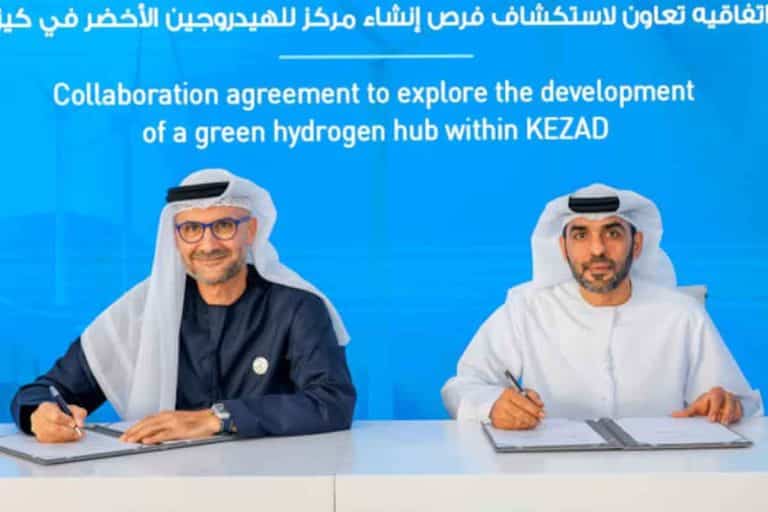
AD Ports Group and Abu Dhabi Future Energy Company PJSC (Masdar), announced the signing of a Memorandum of Understanding (MoU) to jointly explore the development of a green hydrogen production hub within the Khalifa Economic Zones Abu Dhabi (KEZAD).
The project, aimed to serve both domestic and export markets, is in line with the UAE’s National Hydrogen Strategy that aims to scale up local hydrogen production to 1.4 million tons per annum by 2031, and 15 million tons per annum by 2050.
In support of this strategy, Masdar is targeting an annual global green hydrogen production capacity of up to 1 million tons by 2030 and has signed and executed several global collaboration agreements to meet this goal.
The agreement between AD Ports and Masdar was inked on the sidelines of COP28.
Hydrogen could help to reduce global emissions by more than 20 percent by 2050 with demand rapidly increasing in recent years.
The proposed hydrogen production hub could include export terminals of green products to overseas ports, which would attract more investments into the green hydrogen value chain in Abu Dhabi, as well as offer current and future KEZAD and Khalifa Port tenants the opportunity to develop green industries.
AD Ports and Masdar: Green hydrogen partnership
Captain Mohamed Juma Al Shamisi, Managing Director and Group CEO of AD Ports Group, said the MoU not only exemplifies the Group’s shared ambition with Masdar to establish Abu Dhabi as a vital international hub for the production and export of hydrogen and its derivatives but also echoes the country’s leadership’s vision to diversify the UAE’s economy.
Mohamed Jameel Al Ramahi, CEO of Masdar, said as a global clean energy pioneer with nearly two decades of experience in renewables, Masdar adopts a smart ‘first-mover’ approach, entering markets at an early stage and building scalable platforms.
“This exciting collaboration with AD Ports Group exemplifies all of those principles,” he said.
He said given the fact that more than 80 percent of global trade is transported by sea, partnerships like this are vital to ensure integrated green hydrogen value chains.
“Working with AD Ports Group, we’ll explore measures to further decarbonize hard-to-abate sectors by encouraging the use of green hydrogen in port operations and as vessel fuels, while facilitating the import and export of hydrogen,” Al Ramahi said.
Follow us on

