





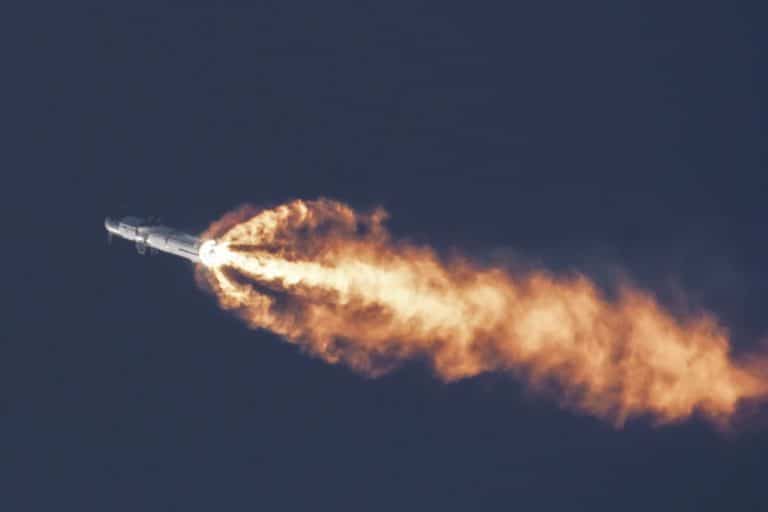
The Elon Musk-owned SpaceX’s Starship, world’s biggest rocket, exploded during its first test-flight to space on Thursday from Boca Chica in Texas.
The next-generation rocket, which was designed to send astronauts to the Moon, Mars and beyond was launched at 8:33 am Central Time (1333 GMT) from Starbase on a planned 90-minute debut flight into space.
While the liftoff was successful, the giant rocket ended in explosion nearly four minutes after liftoff.
SpaceX said Starship experienced a rapid unscheduled disassembly before stage separation and their teams will continue to review data and work towards the next flight test, AFP reported.
Its CEO Elon Musk congratulated the team in a tweet on ‘an exciting test launch of Starship’ and said that he has learned a lot for Starship’s next launch in a few months.
SpaceX called off the debut launch of the uncrewed flight on April 17 just minutes before its scheduled launch time, after a pressurant valve seemed to be frozen in the booster stage.
The US space agency NASA has picked the Starship spacecraft to ferry astronauts to the Moon in late 2025 — a mission known as Artemis III — for the first time since the Apollo program ended in 1972.
Elon Musk’s SpaceX Starship
Starship consists of a 164-foot (50-metre) tall spacecraft designed to carry crew and cargo that sits atop a 230-foot tall first-stage Super Heavy booster rocket.
Collectively referred to as Starship, the spacecraft and the Super Heavy rocket have never flown in combination together, although there have been several sub-orbital test flights of the spacecraft alone.
SpaceX foresees eventually putting a Starship into orbit, and then refueling it with another Starship so it can continue on a journey to Mars or beyond.
According to Musk, the goal is to make Starship reusable and bring down the price to a few million dollars per flight.
“In the long run — long run meaning, I don’t know, two or three years — we should achieve full and rapid reusability,” he said.
Follow us on

