




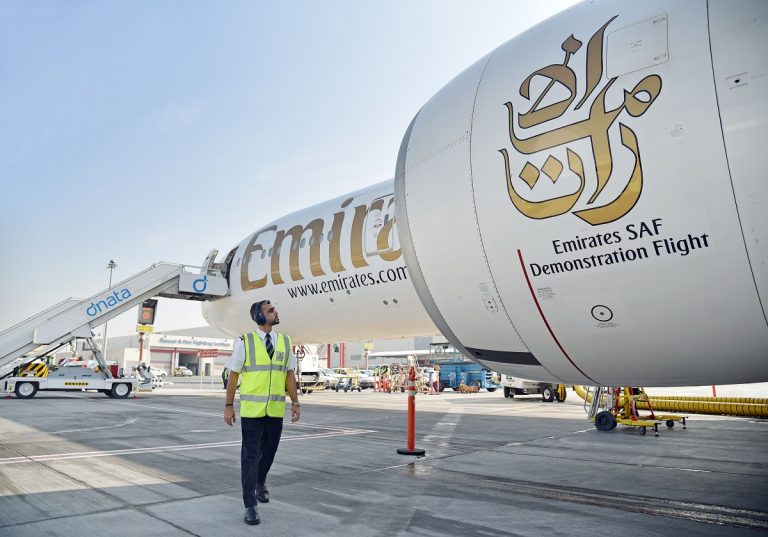
Emirates has successfully operated a flight using 100% Sustainable Aviation Fuel (SAF).
The Boeing 777-300ER flight took off from Dubai International Airport and saw the plane fly for more than an hour over Dubai with sustainable fuel powering one of its engines.
The demonstration was commanded by Captain Fali Vajifdar and Captain Khalid Nasser Akram and is a significant step in the UAE’s “Year of Sustainability”.
Emirates sustainable fuel flight
2023 will see the UAE committed to seeking innovative solutions to challenges such as energy, climate change and other issues related to sustainability.
The flight supports collective industry efforts to enable a future of 100% SAF flying and help advance the UAE’s sustainability objectives.
Emirates’ demonstration flight, the first in the Middle East and North Africa to be powered by 100% SAF, supports broader efforts to reduce lifecycle CO2 emissions as the industry looks to scale up its use of SAF.
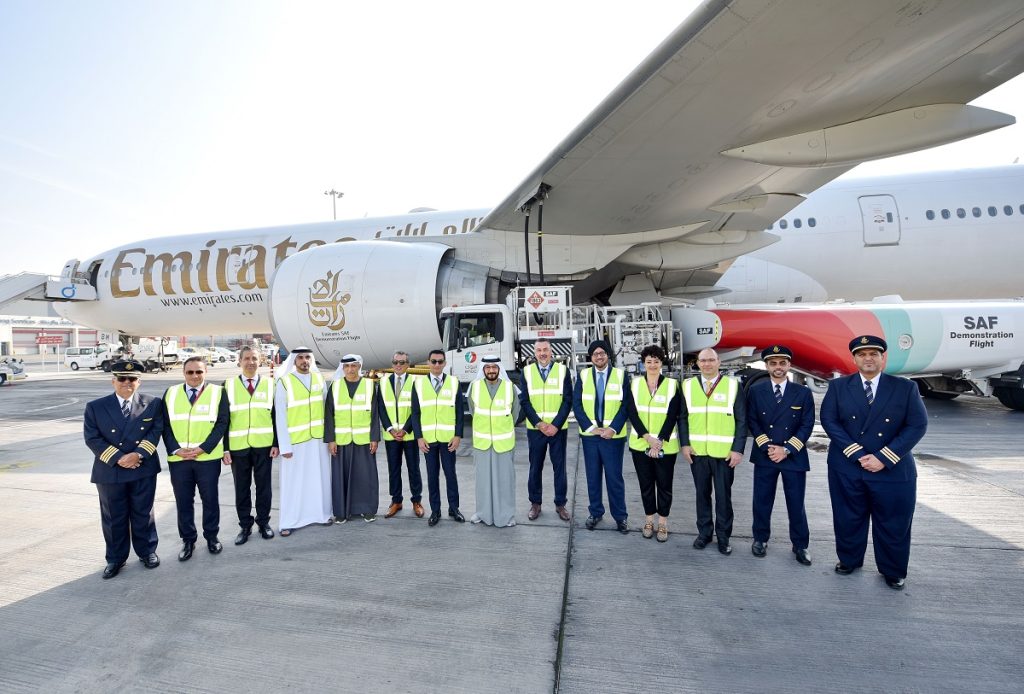
The flights will also help to refine the playbook for future SAF demonstrations, and support future certification where 100% drop-in SAF fuel is approved for aircraft.
Currently, SAF is approved for use in all aircraft, but only in blends of up to 50% with conventional jet fuel.
Emirates worked alongside partners GE Aerospace, Boeing, Honeywell, Neste and Virent to procure and develop a blend of SAF that closely replicates the properties of conventional jet fuel.
At each blend ratio, a host of chemical and physical fuel property measurements were carried out.
After multiple lab tests and rigorous trials, they arrived at a blending ratio that mirrored the qualities of jet fuel. Eighteen tonnes of SAF were blended, comprised of HEFA-SPK provided by Neste (hydro processed esters and fatty acids and synthetic paraffinic kerosene) and HDO-SAK from Virent (hydro deoxygenated synthetic aromatic kerosene).
The 100% SAF supplied one GE90 engine, with conventional jet fuel supplying the other engine.
The test flight further demonstrates the compatibility of the specially blended SAF as a safe and reliable fuel source.
The promising outcome of this initiative also adds to the body of industry data and research around SAF blends in higher proportions, paving the way for standardisation and future approval of 100% drop-in SAF as a replacement for jet fuel, well above the current 50% blend limit.
Adel Al Redha, Chief Operating Officer, Emirates Airline said: “This flight is a milestone moment for Emirates and a positive step for our industry as we work collectively to address one of our biggest challenges – reducing our carbon footprint.
“It has been a long journey to finally see this demonstration 100% SAF flight take off. Emirates is the first passenger airline in the world to operate a Boeing 777 powering a GE engine with 100% SAF.
“Such initiatives are critical contributors to industry knowledge on SAF, and provide data to demonstrate the use of higher blends of SAF for future regulatory approvals.
“We hope that landmark demonstrations flights like this one, will help open the door to scale up the SAF supply chain and make it more available and accessible across geographies, and most importantly, affordable for broader industry adoption in the future.”
Saif Humaid Al Falasi, Group CEO at ENOC praised the achievement as it coincides with 2023 as the ‘Year of Sustainability’, which was announced by the UAE’s President Sheikh Mohamed bin Zayed Al Nahyan.
It also represents a major step towards reducing carbon dioxide emissions and achieving climate neutrality.
He said: “At ENOC, we prioritise working closely with our strategic partners to implement a national roadmap for sustainable aviation fuel. This not only aims to accelerate the decarbonisation of the aviation sector, but also contributes to achieving the UAE’s goals in climate neutrality, enhances the efficiency and conservation of fuel, as well as positions the UAE as a regional hub for sustainable aviation fuel.”
Emirates is committed to supporting initiatives that help minimise its CO2 emissions, and the airline has already made great strides in fuel efficiency and conservation as well as operational advancements.
The airline also supports IATA’s collective industry commitment to reach net zero emissions by 2050, and is exploring opportunities to augment operational fuel efficiency, SAF, low carbon aviation fuels (LCAF) and renewable energy.
Follow us on

