




The luxury watch industry is reassessing its relationship with hype-driven marketing following a three-year correction in secondary market prices, with industry executives debating whether viral product drops strengthen or undermine long-term brand value.
At the Dubai Watch Week forum titled ‘When Labubu beats the Birkin: Luxury in the Age of Hype’, George Bamford of Bamford London, Richard Benc and Misha Doud examined the tension between traditional luxury positioning and contemporary hype culture.
“Hype is not luxury,” Doud said, with two limited edition Labubus hooked onto her red ostrich Birkin sitting by her feet on stage, “Hype is access – can you get something at the right time because everyone wants it? Luxury is ownership.”
The discussion comes as the global luxury watch market valued at $53.6 billion in 2024, navigates the aftermath of pandemic-era speculation that saw certain models trading at 200 per cent of retail before prices collapsed.
Secondary market prices for luxury watches fell nearly 1 per cent in Q2 2024, according to Chrono24’s ChronoPulse index. Vacheron Constantin declined 6.31 per cent, Panerai dropped 6.04 per cent and Rolex fell 1.74 per cent.
The correction has forced bands to reconsider strategies that rely on manufactured scarcity and limited drops – tactics borrowed from streetwear brands that have delivered mixed results for traditional watchmakers.
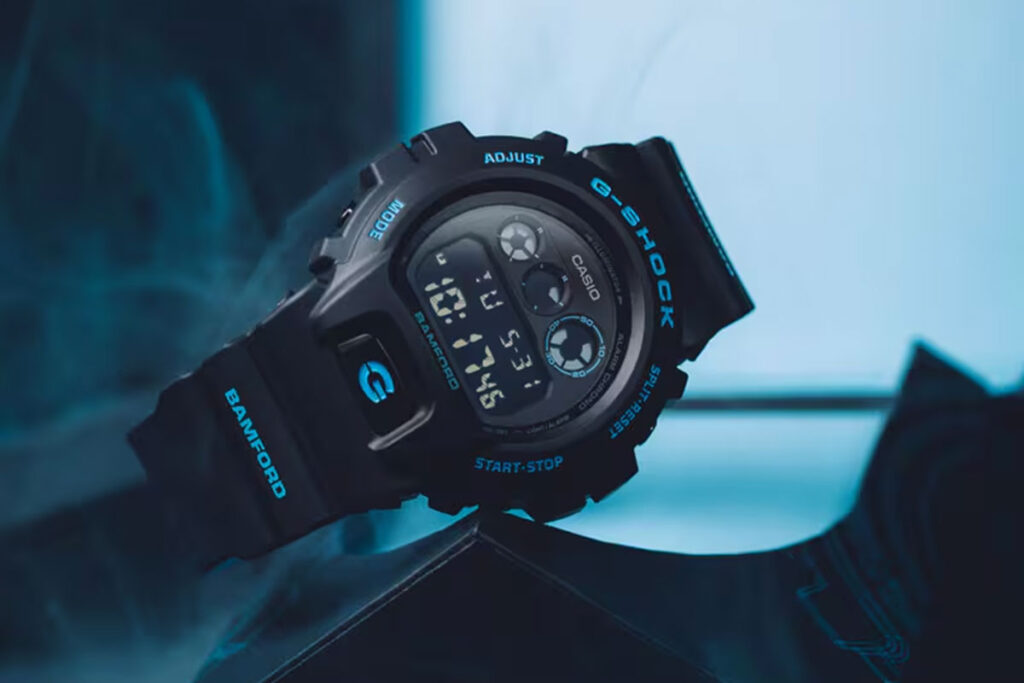
Bamford’s 2023 G-Shock collaboration illustrated both appeal and risks. The product sold out in 90 seconds at launch but also resulted in a broken window, police intervention and street closures on London’s Carnaby street as crowds swarmed the location.
“We had people sleeping outside beforehand,” Bamford said, comparing the incident to the Swatch x Omega MoonSwatch launch that produced similar hype-based chaos.
Benc argued that the distinction between hype and luxury lies in their foundations. “By definition, hype is about buzz and excitement in a particular moment. Luxury is more evergreen – it’s about experience, independence and craft,” he said.
When Benc launched his brand with limited production runs, scarcity resulted from capital constraints rather than marketing strategy.
“I didn’t have very deep pockets, so I couldn’t afford to manufacture many watches. That created scarcity through artisinal craft, not by design.”
As his business scaled, Benc adopted what he called a “sliding scale” approach, drawing from both luxury and hype playbooks. “I’m trying to find that right balance. I don’t want to be here today and gone tomorrow.”
The strategy reflects broader industry dynamics. While offline stores commanded 66.82 per cent of luxury watch sales in 2024, online channels are projected to grow at 7.01 per cent CAGR through 2030, according to market research.
Social media platforms increasingly influence purchasing decisions, particularly among millennials who represent a growing segment of both primary and secondary markets. The hype of the Labubu is a testament to the power of social media in influencing demand. The growth of the Labubu was largely driven by global celebrity endorsements and the blind box model with videos trending on social media of unboxings.
Established manufacturers face challenges when engaging with hype-driven tactics. Doud cited Cartier’s Tank relaunch as a successful execution – generating cultural momentum while maintaining luxury credentials. She contrasted this with brands that pursued viral trends only to see consumer attention evaporate.
Bamford’s collaborations with heritage brands like Girard-Perregaux demonstrates one approach, allowing established houses to “play outside their wall books and tell archive stories in another vein.” However, he warned against overreach.
“If you lean too far one way, whilst the going is good, it’s great but that hype can turn quickly.”
The experts identified Dior’s first Nike collaboration as exemplary – a limited release that maintained value because the brand declined to saturate the market with follow-up products.
The secondary market for luxury watches reached $26.8 million in 2024 and is projected to hit $43.6 million by 2031, according to Cognitive Market Research. Platforms like StockX and Chrono24 have democratised access to limited releases while creating new price discovery mechanisms.
This growth has attracted speculation, with consumers increasingly viewing watches as investments rather than purchases. “People always ask: should I buy this? This is trending now. Will it be worth something?” Doud said. “They’re trying to equate hype with value.”
The recent correction suggests this approach carries significant risk. Products purchased purely for anticipated appreciation have frequently underperformed expectations.
Asia-Pacific accounted for 40.51 per cent of the luxury watch market share in 2024, with millennials representing a crucial demographic for growth. The new generation accesses product education through digital channels, including podcasts, Instagram accounts and online forums that didn’t exist for previous buyers.
Bamford, who recently spoke about watches at a school, explained teenagers’ sophisticated understanding of horology. “Education is 20 times more because of the internet. The knowledge from strap hacking to movement details – they’re going, I love this brand because of this.”
“All of us jump on the hype in our own way,” Bamford said.
The luxury watch market is projected to reach $134.53 billion by 2032, according to Fortune Business Insights, suggesting continued growth despite recent volatility.
“Luxury is ownership, you own it and it stays with you forever,” Doud said. “When something is hype, you fought to get these Yeezys for your kids and then three seconds later, they were thrown out the window.”
As brands navigate this terrain, the experts suggested that the industry is moving towards hybrid strategies that combine elements of both approaches rather than choosing one over the other.
Follow us on

