


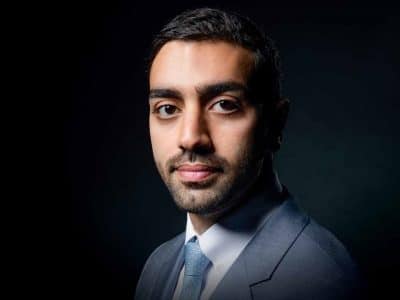

Ziad Makhzoumi, chief financial officer of Dubai-based conglomerate Arabtec, tells Arabian Business why it’s business as usual for the UAE’s largest construction firm.Two years ago, we barely bid for a project,” Ziad Makhzoumi says, frowning lightly. “Two years ago, we were picking and choosing what we wanted. Developers wanted their projects done yesterday, and were happy to pay for that.”
He settles back in his chair. “But things change and so what? There are no guarantees in business. We all have to live with that. This is capitalism.”
As the suave CFO of Arabtec, the UAE’s largest construction firm by market value, few know better than Makhzoumi how the financial crisis has ripped through Dubai’s overheated real estate market. After years of posting double-digit growth, last year saw Dubai’s property boom swiftly turn to bust, paralysing the market and sending contractors and suppliers into freefall.
Investors fled, prices bottomed and, as credit lines dried up, developers stopped paying their contractors. A consortium of British firms claimed to be owed some $600m in outstanding payments from state-backed firms in Dubai.
In the wake of the crash the fate of more than half the UAE’s 1,289 projects, worth $582bn, hung in the balance, reported Dubai research house Proleads.
Makhzoumi might have had a ringside seat to the fallout but, watching him address a packed room at the Arabian Business Conference 2009, it has done nothing to dampen his straight-talking style. No topic is immune.
On Lehman Brothers: “The decision to let it go was a bad one.” On Saudi Arabia: “It is the Makkah of the economic markets, and it has not faltered.” On Dubai: “Contrary to what the global media says, it’s still a safe place. I’ve never had my mobile nicked.”
Even the emirate’s liabilities don’t escape a wry assessment: “Local banks should be paid before foreign lenders; then the liquidity will eventually filter through the economy here,” he suggests, raising an eyebrow.
For Arabtec, the recession has proved a rare blip in an otherwise meteoric rise. Through a blend of hard work and good timing, the firm has built a $560m business riding the growth of Dubai from dusty hamlet, to glitzy city.
So it was inevitable that when Dubai stuttered, so too did Arabtec. In October, the construction titan posted a third-quarter net profit of $45.36m, down 35 percent from the same period a year ago. Shares are down fifteen percent in the year-to-date.
“We were lucky, we hit the boom. We’re very grateful to have had that opportunity. Now, Dubai is going through a restructuring and we have to stick with that,” Makhzoumi says matter-of-factly. “Things have changed, but we have to work together to sort it out.”
The downturn has, however, prompted a sharp change in Arabtec’s focus overseas. From a previously Dubai-dominated portfolio, the conglomerate is now bidding for work in countries including Bahrain, Qatar, Syria and Jordan. The firm, which has around 70,000 staff, recently established subsidiaries in Lebanon and Egypt, is likely to set up a third in Libya shortly and has a fourth planned for Algeria.
In Qatar, the firm’s order book stands at just under AED3bn, and in Saudi it is around AED3.5bn. Arabtec is also building Europe’s tallest tower in St Petersburg; a AED10bn project that will be the headquarters for Gazprom Neft, the oil arm of state-owned natural gas giant Gazprom.
Closer to home in Abu Dhabi, Makhzoumi says Arabtec has in excess of AED2bn-worth of contracts in its order book and is chasing several more lucrative projects.
“We are following up on the two museums, The Guggenheim and The Louvre, two universities that are being expanded, and you have a series of hospitals, six in total,” he says. “And our backlog in Dubai is still around AED9bn. We are slowly moving out of Dubai, not because we want to but because the business is in other areas.”A perk of the slowdown in Dubai is that Arabtec has newly-available resources to drive forward its overseas ambitions.
“We have, I would say, moved more than 2,000 [staff] to Saudi, and we expect to move another 2 to 3,000 in the coming six months. With subcontractors, bidding and operations, we will have an operation of around 12 to 15,000,” Makhzoumi explains. “That’s a sizeable operation.
“In Abu Dhabi we now have a few thousand staff, and in Qatar we have around 4,000.”
So it’s likely to be a profitable year ahead?
“I think 2010 will be, at best, as good as 2009,” he says slowly. “Our transition [overseas] will not show any financial results until 2011. I think 2011 will be the turning point.”
Arabtec might be pursuing new work, but there is also the small matter of the unpaid fees owed to it by Dubai developers. Along with other contractors responsible for turning Dubai from desert to a luxury destination, Arabtec found itself out in the cold when the emirate’s property market collapsed at the close of 2008. Is it getting paid now?
“We are,” says Makhzoumi. “The major changes were in the beginning of the year. Lots of projects were stopped, or just stood still. Since then, there has been payment.
“It’s not as good as the beginning of last year, but we all know what the situation is. There is restricted liquidity and funding, and we’re all managing.”
Has the firm now collected all its outstanding fees?
“We have agreed on a payment schedules [with Dubai developers] and they are honouring that,” he says firmly. “We’re not having any major issues with any of the developers. It has been agreed how the receivables will be paid, [and] with any future work, it’s been agreed how that will be paid. It more or less seems to be on track.”
But that’s not to say that Arabtec hasn’t had its fingers burned in the process. As a result, the firm is now pickier in its choice of client, placing a greater emphasis on financial stability and timely payment. Makhzoumi admits Arabtec has turned down several projects because it “didn’t see commercial viability”.
“We need to know the funding is there,” he says. “We are more diligent and more prudent, and we have to be convinced the funding is there. We won’t mobilise [our resources] without a downpayment.”
It’s the type of caution, critics would say, that foreign lenders might have been wise to display before blindly distributing cash to Dubai corporations. The emirate’s finances have dominated global headlines in recent weeks, following the move by ports-and-property conglomerate Dubai World to restructure $26bn of debt.
The subsequent refusal by Dubai government to guarantee the firm’s liabilities sent the global markets into a tailspin, over fears of fresh bank losses. The move sparked anger among some creditors, who believe that Dubai had given an implicit guarantee that its companies were state-backed. For Makhzoumi, however, there is little use in crying over spilt milk.
“You can bleat now, but the answer is; ‘Grow up boys’,” he shrugs. “This is real life. If you didn’t read the small print, it’s technically your fault.
“You made a lot of money from Dubai historically, now all of a sudden it’s not good? I don’t believe that. Many of the entities in Dubai are cash-positive, a lot are profitable. Dubai Duty Free, Jebel Ali Free Zone, Dubai Ports and so on – these are entities that are still generating cash. It might be a longer cycle, but that’s the nature of the world.
He shakes his head. “The world economy has crashed. The government has put in $4.5 trillion and we’re worrying about $26bn?” He laughs. “Really, it’s a small amount.”
Follow us on

