


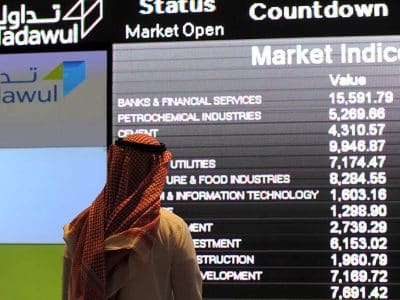

Saudi Arabian banks fell for a second day since Riyad Bank reported below forecast first-quarter earnings, weighing on expectations for the sector, but telecoms and petrochemical stocks helped lift the index TASI.
Riyad Bank dropped 3.8 percent, Samba Financial Group fell 1.2 percent and Arab Bank slid 0.9 percent.
The bank index hit a 15-month high on March 28 on expectations that lenders’ profits would surge this year after they took large provisions in the fourth-quarter against bad loans, but these hopes now look increasingly premature.
On March 31, the Saudi central bank said banks’ profit in the January-February period fell 15 percent from the year earlier period.
“Banks are over the worst, but are still following conservative lending practices and there is not the demand from the high quality borrowers they want to do business with,” said a Saudi analyst who declined to be named.
“It will probably be the second or third quarters before loan growth picks up.”
Etihad Etisalat climbed 1 percent and Rabigh Refining and Petrochemical Co added 0.6 percent.
The index edged up 0.01 percent to 6,884 points.
Dubai’s index DFM ends lower after gaining for two sessions as volumes slumped to a three-week low. Dubai Financial Market headed losers, falling 1.5 percent to 1.95 dirhams after Shuaa Capital slashed its price target on the stock to 1.20 dirham from 1.58 dirham.
Arabtec fell 1.5 percent as the April 16 deadline for due diligence on its 70 percent stake sale to Aabar Investments nears.
Emaar Properties fell 0.7 percent, slipping from Monday’s 14-week high. The stock had surged on talk the developer was looking to sell a building in Dubai’s Emaar Square currently leased to HSBC.
“Information on (the) sale of HSBC building is not correct,” an Emaar spokesman says. “HSBC building is still owned by Emaar.”
Dubai’s index fell 0.7 percent to 1,822 points, taking its losses to 3.1 percent since hitting a 14-week high on March 28. It had surged following Dubai World’s March 25 debt restructuring offer. Volumes fell to their lowest level since March 24.
“After the Dubai World offer, liquidity went through the roof as a lot of fast money entered the market,” said a Dubai-based analyst who asked not to be identified.
“But the announcement did not trigger long-term money to come in and so the market was not able to sustain gains.
“We need more clarity on the debt restructuring, how long this process will take and whether other big Dubai companies will also restructure.”
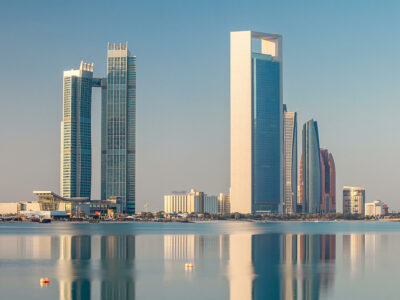
Abu Dhabi’s index ADI fell 0.2 percent to 2,860 points as volumes slumped to a six-week low. Aldar Properties and Sorouh Real Estate dropped 1.3 and 1.2 percent respectively.
Masraf Al Rayan hit an 18-month closing high after reporting a surge in first-quarter profit, boosted by rising deposits and an increase in financing activity. Rayan climbed 3.3 percent to its highest close since Oct. 20, 2008.
“Masraf’s results were very good and its assets grew faster than expected,” says Keith Edwards, head of asset management at Doha-based investment company The First Investor.
“Masraf’s numbers might not be significant in terms of expectations for other banks – they tend to dance to the tune of QNB.”
Qatar National Bank climbed 0.6 percent, hitting a 20-month intraday high. On April 6, QNB reported a 25 percent rise in first-quarter profit.
Industries Qatar added 1.6 percent, helping the index climb 0.8 percent to 7,801 points, its highest finish since Oct. 22, 2008.
“Fundamentals look good – the banks will benefit from Qatar’s infrastructure spending and Industries Qatar is underpinned by its expansion plans and an improving global economy,” says Edwards.
“I’m not so sure about the rest of the private sector such as real estate.”
Bahrain’s measure BAX fell 1.6 percent to 1,544 points as investors resumed profit-taking in Ahli United Bank. The lender fell 7.4 percent. It was down 17 percent since hitting a 17-month high on April 7, a day after investors agreed to sell a 25 percent stake in the bank.
Agility plunged after US authorities filed a revised indictment against the logistics provider accused of defrauding the US military, weighing on Kuwait’s index KWSE, which made its largest fall for eight weeks.
Agility fell 7.8 percent, giving up Monday’s gains that were spurred by the firm reporting a 22 percent rise in fourth-quarter profit. It also proposed a 40 fils per share dividend, despite the ongoing court case.
“Agility’s results were fairly good, but a lack of provisions may show some hubris on the company’s part,” says Keith Edwards, head of asset management at Doha-based investment company The First Investor.
“We would not invest in the stock right now and it will bumble along around current levels until the court case is resolved.”
Agility was down 45 percent since US authorities made a first indictment in late November.
Kuwait’s index KWSE fell 0.8 percent to 7,487 points, its biggest one-day drop since Feb. 17.
Kuwait Finance House climbed 1.8 percent after saying it had received approval to buy back up to 10 percent of its shares. (Reuters)
Follow us on

