




Despite the market volatility, and the recent dips that the cryptocurrency market is facing, investor interest in digital currency remains high, especially in Dubai.
In this week’s episode of The Spencer Lodge Podcast, in partnership with Arabian Business, Nick Saponaro, the CEO of digital exchange platform Divi, said the emirates remained ahead of the globe in its response to cryptocurrencies, also giving tips on how to mitigate risks and invest wisely.
“Because Dubai is the city of the future, and everybody is looking to be at the forefront of the next big thing, people are at least more receptive to crypto,” said Saponaro.
“There’s a lot of crypto millionaires and billionaires here that are establishing companies and building new projects but I think even those who are unfamiliar with crypto are getting into it, or are even more receptive to what it is and what it can become, versus other countries. For example we were in Spain in November, and they’re just getting started with crypto and are still a little bit averse to it, thinking it’s a scam or money laundering,” Saponaro explained.
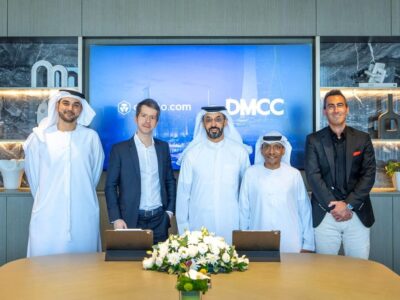
“Meanwhile, this city is just full-on embracing it and trying to make the most out of it, even establishing new guidelines and laws that make it easier for people like us to come and build businesses. That’s what I love Dubai, because I feel like everyone I meet is crushing it. And I was like, I’m not crushing it as hard as them and I need to. It’s inspirational,” he continued.
An only child kid who grew up on the East Coast and was always into technology, Saponaro joined Divi in 2017 and was appointed CEO eight months ago.
In its essence, Divi’s philosophy is to make cryptocurrencies “accessible and easy to use for anyone to pick up – not just the tech-savvy people, or the people who are sophisticated investors, but the grandmother, or someone in the sub-Sahara. Everyone,” explained Saponaro.
The digital currency exchange is waiting on a pending patent on a solution which allows users just to click a button and start earning coins through Divi’s wallet.
“Outside of all of the misnomers, propaganda, competing agendas and narratives [circulating against crypto], it’s really important for us, to create a familiarised ecosystem that makes it simple, and something that you can understand right off the bat,” said Saponaro.
“The value chain of finance right now is heavily fragmented where you have all these wallets and coins so it becomes overwhelming and confusing. If we can bring all of that into one place and push the complexity to the background, because none of it really needs to be apparent to the user, the user just wants the outcome they want so you just give them what they need.
“It’s not just about storing money anymore: It’s about accessing this whole universe of finance. So we want to bring all of that into one place, and eliminate a lot of the friction that is caused by both the fragmentation and the over complexity that comes up,” he continued.
Trading securely
Divi’s crypto wallet was launched in October and already has have 25,000 grass-root users. And while ease of use is important, Saponaro also brought up the security element, comparing wallets like Divo to centralised services.
“Basically, you have a choice to make as a developer, you can make sacrifices to get to that ease of use quicker and we see that with some of the centralised services where your money is not held by the individual but by custodial service that they’re using; you’re just recreating a banking system essentially, which is antithetical to what crypto is built around,” he said.
“As developers, we don’t think that sacrificing security for convenience is necessary. We made a lot of sacrifices as humans already with a privacy with social media for the convenience so we shouldn’t give up control of the last thing that we have control of which is finance.”

“You have a responsibility as a developer who does understand what this technology can do to build a service that protects the user, and is easy at the same time. Don’t just try to get to market as fast as possible. Because if we just turn around and recreate the same system with a different face, then we’ve really gotten nowhere,” continued Saponaro.
Investing in cryptocurrencies
Not all cryptocurrencies are created equal and some make more solid investment sense versus others deemed to be riskier.
“You look at the fundamentals of each coin that you invest in and obviously, Bitcoin has the strongest fundamentals of any coin out there: It’s the longest running, it has a lot of institutional support and it’s very unlikely to disappear; there’s no central authority, so it can’t really be shut down. Then it kind of goes down from there,” said Saponaro.
“There’s a lot of high-risk assets like meme coins and things like that, that might earn you a high yield if you’re lucky or get in early enough. That’s gambling, full stop gambling.
“It’s the top probably 300 that have a majority of the market cap and after that the trickle down is so negligible that it’s not even worth tracking. Of course, it’s the top 50 that are going to hold a lot of value because then you have large-scale institutions and its operating more like the traditional financial market in that level,” he explained.

Divi recently entered into a three-and-a-half-year partnership with Spanish professional football league La Liga in the MENA, Southeast Asia and China regions.
“One out of every six La Liga viewers owns crypto so we want to increase that number. As we’ve talked about, there’s this natural aversion to new things or things you don’t understand, so with the La Lega partnership, we’re actually able to get on the ground with fans and show them, for example, how you can buy a beer with the Divi wallet,” he explained.
Asked how Divi makes its money, Saponaro said they have several different revenue streams, including software-as-a-service products such as its staking service, Fiat on-ramp and off-ramp, trading.
“Things like that all generate fees and those help the bottom line to some extent, but what we really make money from is integrating our system with other enterprises,” he said.
“Every single business in the world will have some element of crypto integrated with it at some point. It’s just the same as every business eventually had a website and eventually had a social media, eventually an app. These things happened because customer demand. For us being with La Liga has definitely opened a lot of doors to those enterprises and many of these exchanges and other high tier businesses in crypto’s primary revenue stream is not the retail customers but the business clients,” continued Saponaro.
Follow us on

