






Earlier this month, Dubai announced the Education Strategy 2033, a comprehensive new plan targeting a significant shift in the education system. A couple of weeks earlier, the emirate welcomed a new addition to the country’s higher education and research community with the announcement of Dubai National University.
Together, these developments are a clear indication of the pace at which the country is becoming a world-leading destination for higher education. More than that, these announcements nod to a wider trend in which the region is gravitating towards the centre of the global scientific and innovation agenda.
In Dubai especially, we are witnessing a resurgence in Arab leadership in scientific discovery that could herald the dawn of a new Islamic Golden Age, akin to the period between the eighth and 13th centuries, when Muslim scholars led advances in fields like life sciences, economics and mathematics.
Today, the UAE has an extremely robust scientific ecosystem comprising several world-leading international universities and three institutions ranked among the top 100 in the QS World University Rankings.
In one sense these education hubs are engines of national development, powering capacity building and economic diversification. In another, they are connecting trailblazers and innovators from around the world like never before, facilitating a flow of knowledge, expertise and data.
Having worked in both the UK and the Gulf, I have witnessed first-hand the impactful research being conducted in both regions, as well as how knowledge exchanges benefit this research. On one hand are the UK’s Russell Group universities, which have been responsible for some of the most seismic scientific discovers of the last century.
This group of 24 research-intensive institutions, some dating from 1096, count almost 200 Nobel prizes between them, granted for splitting the atom, understanding DNA and developing computers, among other achievements. Then, there are the new ambitious centres of learning being built in the Gulf with massive government investment and contributing significantly to scientific progress.
The opportunity of the hour is to bring the knowledge and talent from all these different ecosystems together in order to tackle some of humanity’s greatest challenges. For this we need a platform like Dubai.
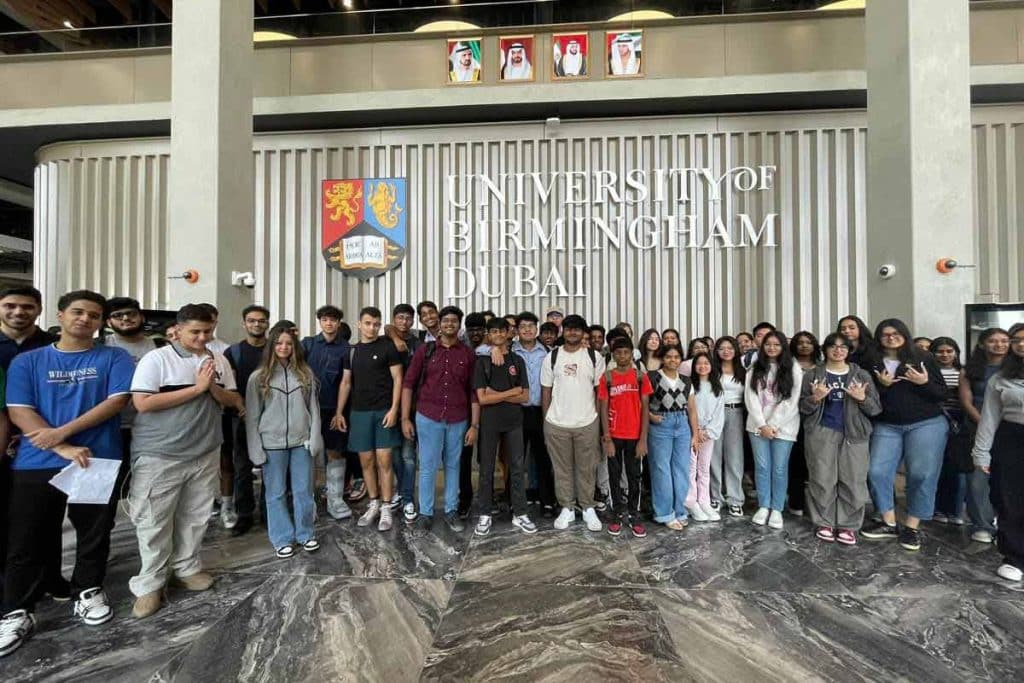
Home to 190 nationalities, the emirate provides a place for academics, researchers and bright minds from around the world to collaborate – the University of Birmingham Dubai alone has students from 96 countries.

And with more than 30,000 students currently enrolled in university programmes in Dubai, and the number of international students choosing to complete their higher education in the emirate increasing by 12 per cent in 2023, this trend shows no sign of slowing.
One of the reasons for Dubai’s magnetism is its geographic position connecting continents and markets in a way that few others can, especially in such a globally complex geopolitical landscape that often prevents cross-border scientific collaboration. The many international institutions that call Dubai home – which today numbers some 30 globally recognised universities – connect the emirate to a global network of organisations representing a huge pool of people, research and resources.
One example is the University of Birmingham Dubai, opened by Sheikh Hamdan bin Mohammed Al Maktoum in 2022, creating a bridge between a UK Russell Group institution and one of the world’s most dynamic innovation hubs.
At COP28, the university’s UK and Dubai campuses worked together to develop a major climate report to support policymakers, businesses and wider society to tackle climate change. The report demonstrated how research institutions are a powerful civic force for good, informing governments, societies, and industries on critical challenges.
But the real potential here – something Dubai can help to unlock – is when these research institutions collaborate. That is exactly what happened during COP28 with the formation of the Universities Climate Network (UCN), a network of 35 UAE-based universities and higher education institutions working together to drive engagement among youth and academia.
The group established the MENA Climate Solutions Research Network to tackle critical climate challenges within the region by implementing solutions aligned with the 2030 Climate Solutions – Implementation Roadmap.
In doing so, the very best institutions in the country brought their talents, resources, networks and facilities to bear on climate change, leading a multidisciplinary approach, encompassing technological innovations, policy frameworks, and capacity-building efforts, to drive progress where it’s needed most.
The UCN collaboration demonstrates the power of academic collaboration. Perhaps more pertinently, it points to a strong will within the UAE’s education ecosystem to unite under formidable academic alliances which can help local, regional and even international communities to form effective policy, drive climate action, advance technologies, protect public health and address other critical challenges.
With yet another addition to our community following the announcement of Dubai National University, and a new, robust education roadmap for the next decade, these alliances of scientific discovery are only set to grow stronger – as is the Arab world’s role in the global science, innovation and research agenda.
Follow us on

