





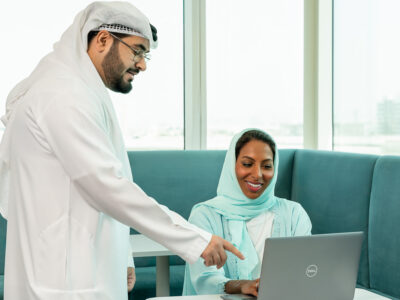

Whenever the discourse shifts to women’s workforce participation in the Arab World, I remember a profound quote by renowned Islamic scholar and Sufi mystic Rumi: “Out beyond the ideas of wrongdoing and right-doing, there is a field. I’ll meet you there.”
Though subject to multiple interpretations, this quote always seemed straightforward to me: A proclamation urging us, the collective, to transcend beyond the self-imposed and culturally sanctioned limitations; to connect at a higher level of truth. I have always viewed women’s empowerment through the prism of that school of thought.
Today, cities like Dubai have embodied the capacity to realign the bounds of conventions and social mores, enabling females to break the “glass ceilings” and set good precedents for their kind to follow suit.
However, women business leaders are not merely holding themselves to the standards of their male counterparts; they are manifesting inherent qualities and strengths that the conventional, largely male-defined business paradigms weren’t acquainted with: Compassion over cut-throat corporate culture and collaboration and community over unhealthy competition. That differentiation is now rebalancing the business equations in the region.
The world is their oyster
After coaching hundreds of successful Arab women business leaders, I unearthed a recurring element in their success stories: The ability to decouple from the stereotypes, stigmas, and repressive dogmas associated with patriarchal systems.’
Encouraged by their self-beliefs or family members, those leaders refused to be indoctrinated into cultural limitations and didn’t take “no” for an answer. But instead of resorting to overt dissent, they took refuge in alternative avenues such as the internet.
As it turns out, the internet has played an empowering role in women’s workforce participation by providing virtual mobility. The new-found ability to connect to prospective employers and collaborators globally ignited in many females an entrepreneurial zeal that had eluded them historically.
As nearly 90 percent of business functions boil down to networking, which the internet facilitates without geographical limitations, women who enhanced their digital dexterity have excelled. While operating in the comfort of their homes, many have driven measurable business outcomes far and wide.
In fact, I can tell, from my hands-on experience of supporting several budding entrepreneurs, that many solemnly believe the only person who can stop them today is themselves.
Collaboration over competition
Multiple studies have substantiated that females are better at collaborating. Exploring the reasons, a Harvard Business Review report said that women’s proficiency in collaboration boils down to their biological capacity to care for the collective.
Unlike men, who by design are known to internalise a collaborative effort, women are generally wired to ensure every member succeeds in a team. Likewise, empathy and compassion, too, are women’s forte. Such qualities were brought to the fore by the pandemic when widespread crisis called for greater compassion than corporate calculations.
The increase in female leaders is thus the rise of positive qualities in business ecosystems — a welcome development. In the Arab World, women leaders exude such character strengths at a higher rate and intensity. That is because, despite their growing workforce participation in recent years, they continue to be severely outnumbered by their male counterparts, leading to higher fraternisation between themselves.
So, women leaders in the region have forged close-knit communities where different perspectives are brought to the table, challenges are acknowledged, solutions are brainstormed, and support is rendered.
Women’s leadership is an untapped opportunity
Arguably, one can ascribe a “butterfly effect” to women’s leadership — the probability of a woman leader inspiring several young girls to follow in her footsteps and setting off a chain of events. Today, it is heartening to see how regional female leaders, notwithstanding their small numbers, are blazing the trail for the younger generation.

So, there is an obligation and an incentive for regional governments to empower women further because their trailing workforce participation, OECD says, is costing MENA nearly $575 billion annually in lost opportunities. The untapped value is not only quantitative but also qualitative — an impediment to more collaboration and compassion-led leadership in business ecosystems.
Fortunately, policymakers in growth economies such as the UAE and KSA are subscribing to the notion of promoting female leaders to unlock multi-fold value, as evident from a host of supporting policies and reforms in recent years.
For global organisations, such shifts call for a re-evaluation of prevailing hesitancies, if any, about women’s place in the Middle East’s business economics. As nations in the civilised world collectively gather their efforts toward common causes such as sustainability and the balance of power, unlocking the full potential of women’s leadership in the Arab World could prove to be monumental.
Follow us on

