



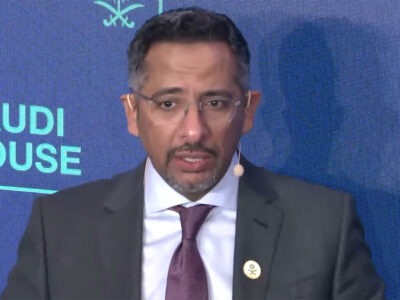

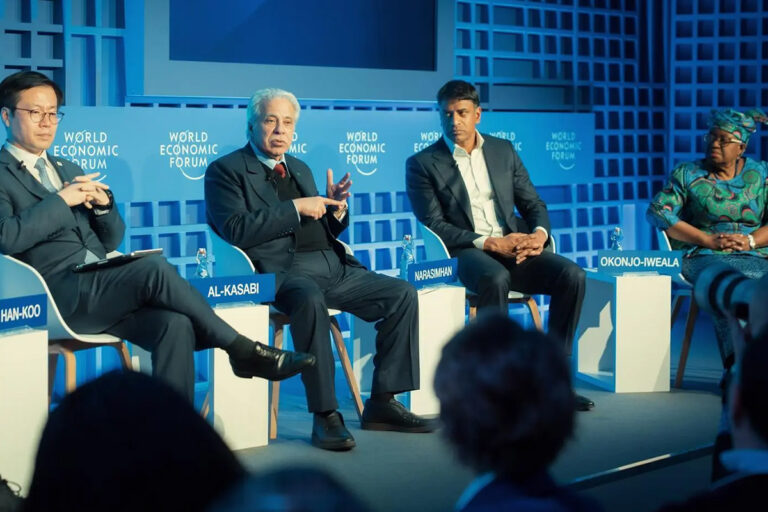
Saudi Arabia is positioning itself as a stable hub linking Europe, Asia and Africa as global trade becomes more fragmented and supply chains are reshaped by geopolitics, senior Saudi ministers said at the World Economic Forum in Davos.
Majid Alkassabi said the Kingdom stood to benefit from a shift away from open multilateral trade towards more managed, rules-based systems.
“Trade today is definitely shifting from fair trade to a managed and rule-driven trade model,” Alkassabi said during a session titled Many Shapes of Trade. “For us in Saudi Arabia, we have a strategic location, we have a lot of resources. We could become a bridge economy. We could become a connector economy.”
He said Saudi Arabia aims to act as a logistics and trade hub connecting Africa, Europe and Asia, building on investments in ports, transport infrastructure and industrial zones under its Vision 2030 economic reform programme.
That external positioning was reinforced by Faisal Alibrahim, Minister of Economy and Planning, who said the Kingdom’s appeal to investors lies in policy predictability and long-term stability.
“Stability is not something you can buy; you have to build it,” Alibrahim said during a separate session titled A Check-In on the Saudi Economy. “It has to accumulate with time for it to be the right kind of stability that nurtures prosperity.”
Alibrahim said Saudi Arabia treats stability as a “discipline” across policy, regulation and execution, arguing that predictability has become a competitive advantage as global uncertainty rises.
FDI rises as global flows fall
“In 2024, foreign direct investment globally dropped 11 per cent, while FDI in the Kingdom increased by 24 per cent,” he said. “Stability also shapes the quality of the investments that are coming into the Kingdom.”
He said trust underpins trade and investment decisions, allowing businesses to plan ahead. “One of the rarest things is that a commitment made today will be honoured tomorrow,” Alibrahim said.
Saudi Arabia has introduced wide-ranging reforms under Vision 2030 to diversify its economy away from oil, open sectors to private capital and streamline regulation. Alibrahim said reforms must go beyond policy announcements to enable long-term decision-making in the private sector.
“Reform on paper is not enough,” he said. “It needs to be combined with a streamlined regulatory framework that enables businesses to think long-term and navigate uncertainty with more confidence.”
Follow us on

