




Having been a business transformation consultant for many years, drawing on my experience working in ethical supply chains, I have been dealing with issues surrounding Diversity, Equity & Inclusion (DEI), Corporate Social Responsibility (CSR) and Environmental, Social and Governance (ESG) since before some of the terms were invented!
Back in the 90s, associated initiatives were often seen as ‘passion projects’ by an influential individual – such as the CEO – tolerated by the rest of the board, viewed very much as on the fringe of mainstream commercial activity.
Fast-forward to the 2000s – and movements such as #BlackLivesMatter and #MeToo made world headlines and accelerated interest.
This interest grew during the pandemic, the resultant lockdown and fuelled by the alarmingly widening gender gap, Millennials and Gen Zs voices are getting louder and increasingly clamouring for change, influencing investor decisions, executive priorities and government legislation.
But whilst many of us know of the moral justification for pursuing DEI initiatives, one of the problems that has vexed organisations, is their ability to understand the impact of their DEI initiatives on social and business performance metrics.
Since DEI touches every part of the business and supply chain, it’s sometimes difficult to know where to start, and which action will have the greatest impact.
Many organisations have attempted to implement their DEI strategy only to find that it fizzles out into initiatives with unproven results, leading to a lack of executive support.

This is reflected in a recent survey from HR Research in 2021 involving 387 global HR Professionals, which identified the top 3 challenges seen by DEI Leaders to increase the benefit of DEI Initiatives in their organisations:
- 35 percent reported lacking access to DEI-relevant metrics
- 34 percent reported difficulty understanding potential benefits
- 33 percent reported struggling to maintain leadership support
In the fast-moving pace of business, an essential part of achieving success and moving from theory to practice rests with keeping robust and timely data. If you don’t have the data, you can’t understand how initiatives are impacting both the top and bottom line. To quote Peter Drucker, the influential thinker on management theory ‘What gets measured, gets done’.
Without the data, DEI leaders run the risk of losing previously declared leadership support, getting ‘trampled underfoot’ in the race to prioritise the funding needed for policies, training and other related activities to achieve strategic objectives.

A 2021 Harvard Business Review Analytics Survey stated “The biggest problem for those [DEI professionals] who are not successful, is a lack of both representation and genuine commitment among senior leaders.” HBR: Creating a Culture of DEI
But where to start?
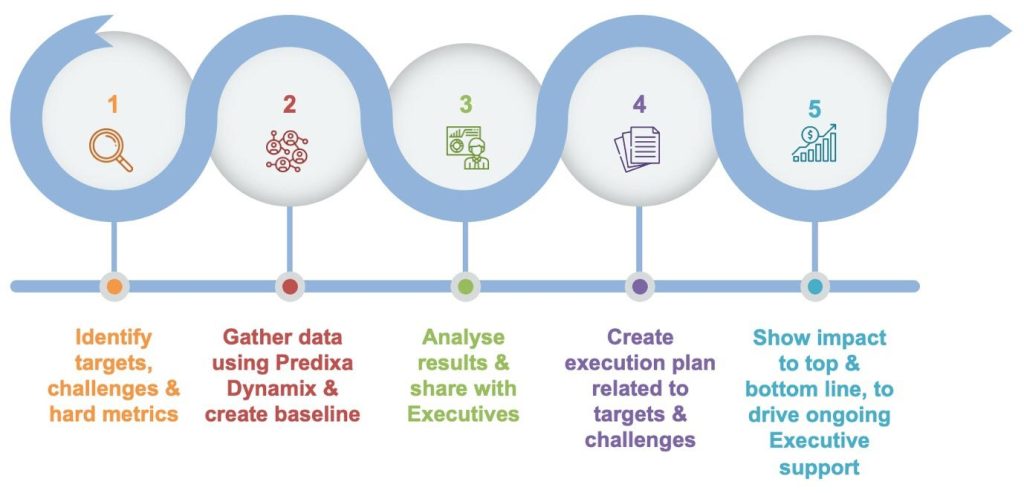
When Predixa works with clients (see below) we suggest to firstly establish targets, challenges – and include hard metrics. Then, gather data to create a baseline against which to measure and monitor progress towards those targets and overcoming challenges.
Include key performance indicators (KPIs) as well as quantifying the impact on softer aspects, such as the inclusiveness of the culture and organisational commitment. Visibility of the results helps business leaders make informed decisions, to support and direct targeted action to further improve results.
Whilst the last few years have proved a challenge (and we are not out of the woods yet), many businesses have recognised that DEI is no longer something to be considered at a later date.
It is an urgent commercial imperative for organisations to remain competitive; retain vital employees; meet Government targets; keep key stakeholders happy, and build resilience for the future – thereby impacting both the top and bottom line.
DEI is here to stay and this train is leaving the station, but to maintain momentum and Executive support…it all starts with the data!
Paula Newby, CEO of Predixa.
Follow us on

