





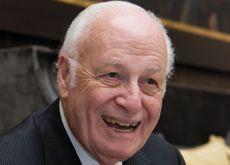
As a financial adviser to the last three US presidents, Stanley Tate has had a ringside seat for the rise and fall of America’s economy. Now, the Obama insider talks finance, free markets and why US taxpayers shouldn’t be bankrolling the bailouts.
Few people can claim to have ‘seen it all’ like Stanley Tate. If you can name a major 20th century financial crisis in the US, the 81-year-old has either lived through it or had a hand in resolving it.
For an octogenarian, he’s got unbelievable energy. He sleeps for only a few hours a night and claims he can work for 60 hours on the trot without rest. Walking to one of the plush meeting rooms in the Capital Club, part of Dubai International Financial Centre, Tate takes great delight in relaying how he underwent a series of tests when he was younger to establish how much sleep he required. The answer was four hours.
I don’t think you will see any improvements in 2009. You’re probably talking about some bottoming out in the early part of 2010 but no major recoveries.
“Think of all the advantages I have in producing all that material when you are asleep,” he grins, pouring lashings of milk into his coffee.
He’s certainly crammed a lot into his life. Currently an informal adviser to the Obama administration, Tate is considered one of the fathers of US real estate. As a senior financial aide to the three US administrations preceding Obama, Tate’s knowledge of America’s economy – both its highs and lows – is profound. He had a ringside seat in the country’s most recent financial crises, namely the collapse of the REIT (Real Estate Investment Trust) industry in the 1970s and the 1980s savings and loans (S&L) fiasco, which saw the collapse of more than 700 related associations.
History has shown that in times of panic, the heads of the world’s most powerful nation have repeatedly turned to Tate for guidance. And they are still doing so. Tate is regularly in touch with Obama’s chief economic adviser Larry Summers and Tim Geithner, the under-fire treasury secretary, though he can recall only one conversation with president Obama since he stepped into the oval office.
For someone so closely associated with White House dealings, Tate’s censure of its key economic figures is startling. With the gravitas of the elder statesman, he has no reservations in criticising president Obama’s economic policy – and specifically, his team.
“The team he has put together, the economic team, are book economists rather than businessmen economists,” he puffs indignantly. “He needs people who are businessmen, who understand the needs of operating a company to make a Friday night payroll when you need to raise capital. He needs people who are more pragmatic at arriving at solutions for the prolongation of a business rather than just to throw money at it. I think that’s a big mistake.”
Unlike the rest of the world, Tate is slow to gush over president Obama. He readily calls him a “very bright man”, but is more measured on Obama’s response to the credit crisis, warning there is risk the new premier will “move too fast” and be too “aggressive” in his economic policies.
Certainly, Obama has unveiled some big numbers to match his bold budget ambitions. In February the Senate waved through Obama’s $787bn stimulus bill, which is tasked with kickstarting America’s battered economy and creating four million jobs. Meanwhile, the Federal Reserve said earlier this month it would pump $1.2bn into the economy to buy up government debt.
The latest proposal, unveiled two weeks ago, outlined a plan to strip banks of up to $1 trillion of toxic assets in a bid to unclog the credit markets and steady America’s financial institutions.
In Tate’s eyes, it is too much too soon. The tactic of throwing money at a poorly understood problem, he predicts, is one bound for failure.
“What is going on with the Obama administration is that I don’t think a far enough analysis has been made to make a determination of what the problems are,” he reasons.
“It’s similar to going to a doctor and saying ‘give me the medicine but I don’t have time to let you diagnose me’. In order to prescribe the medicine you have to have a better determination of what the illness is.”
The new administration is doing without Tate’s wisdom today. He’s cancelled a meeting with the team to travel to Dubai and promote his US-based property company, Tate Capital Real Estate Solutions (TCRE). Founded by Tate in 1949 – he is still the firm’s chairman – it has forged a tie-up with Dubai-based LRIM Investment Management, a private equity firm focused on real estate.
The deal is set to capitalise on TCRE’s expertise in acquiring distressed assets and devising asset work-outs in depressed economic times – an area Tate knows a lot about. During the 1970s REIT collapse the New York Federal Bankruptcy Court named him as a trustee for listed REITs caught up in the crisis, including Associated Mortgage Investors. Many banks received 100 percent of their invested capital back.
In the 1980s, with the emergence of the S&L crisis, Tate and his team were called on again to bailout the industry. In response to the market collapse, the government established and sponsored the Resolution Trust Corporation (RTC), a vehicle charged with liquidating assets – largely real estate-related – from insolvent S&L associations. Former president Bill Clinton appointed Tate as CEO of the RTC in 1993.
By the time the corporation was handed over to a federal body in 1995, it had resolved some 747 S&L associations, with total assets of more than $390bn.
There are clear parallels between the S&L crisis and the current credit crunch. Both were caused by bad lending decisions. Now, with economists warning darkly of another 1930s-style depression, a devastated housing market, billion dollar bailout packages and the near collapse of Wall Street, Tate is in his element.”I personally believe in a free marketplace to let those corporations that are going to fall, fall. If they have to go bankrupt, that’s ok too,” he says, referring to the multibillion dollar bailout funds channelled into US banks and carmakers in the last few months.
Two of America’s biggest car manufacturers, GM and Chrysler, have received $17.4bn of government money. Now the pair have asked for $22bn more. The debate over federal aid has now become as much a political question as an economic one: is the government right to bailout these companies, once the powerhouses of America’s battered economy? And at what cost?
“From the industry standpoint, they [carmakers] recognise this as their only ability to survive. I’m less concerned with their ability to survive. I’m not sure by putting that money in, it is going to save them anyway,” Tate says bluntly.
Perhaps more controversial was the $700bn banking bailout approved in October by Congress during George Bush’s last few months in office. The public found it tough to swallow a plan that ploughed tranches of taxpayers’ money into rescuing institutions that many Americans felt were behind the financial crisis in the first place.
Tate, unsurprisingly, is scathing about the package, which was aimed at buying up the bad debts of struggling banks and lenders on Wall Street.
“A large amount of that had no transparency, a lot went to banks. That’s money that has already been expended and no one seems to have any handle as to where it went and what good it did,” he notes.
Rather than saving these companies, he argues, a better plan would have been to allow free market forces to run their course. “There would be other businesses that would have come into play that would pick up that vacuum,” he says. “I believe that would be a more secure recovery than the manner in which it is being handled under the stimulus packages.
“They are feeding some of these industries with capital with no assurance that even the amount of capital they are feeding them is going to be sufficient to make them viable.”
Asked what he would do were he in the president’s shoes, Tate shows not a flicker of hesitation. “I would have directed it in-line with more of an immediate help,” he says. “This would involve instant creation of jobs through government-chaired infrastructure jobs such as road jobs and plant work.
“This would create an employment base, so that when you get the economy back, it would stop rising unemployment and create a more steady income stream. This increases the opportunity for money to be spent and accumulated, so borrowing has an availability of capital. These things have a tendency to grow and with growth you’ll eliminate all of the problems.”
A young boy during the Great Depression and a spectator to the US’s worst economic cycles in the latter half of the 20th century, Tate is acutely aware of just how serious the international financial crisis is.
“It’s going to last a while, I don’t think you will see any improvements in 2009,” he says frankly. “You’re probably talking about some bottoming out in the early part of 2010 but no major recoveries.
“By 2011 I would like to think you’ll see some resurgence in the marketplace.”
In the interim, Tate would like to see regulations imposed again on the banking industry to stabilise growth – rules that both previous Republican and Democrat governments relaxed and then eliminated over the years.
Alan Greenspan, the former chairman of the Federal Reserve, was a strong advocate of self-regulation in the banking sector but Tate believes the results of this approach now speak for themselves.
“Greed became the driving force. Greed has no basis in business,” he says forcefully.
It’s a message he hopes the new administration takes to heart. If only its predecessors had.
Follow us on

