



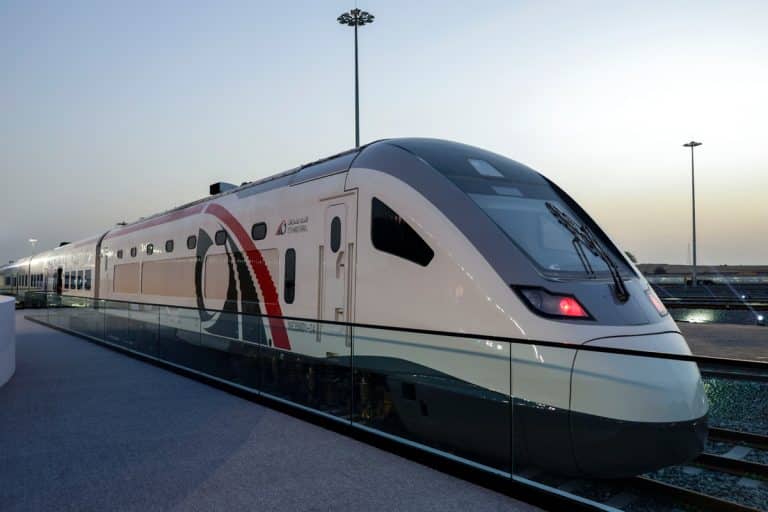
Etihad Rail has successfully completed the UAE National Rail Network, a massive project spanning 900 km that links all seven emirates with a primary railway.
A new video by Etihad Rail on Twitter confirmed that the UAE’s much-awaited rail network is now complete.
The network will also connect four ports in the UAE, as well as logistics hubs, and will be a crucial component in the country’s logistics and transportation infrastructure.
In addition, the Etihad Rail track will have 593 bridges and crossings, a fleet of 38 locomotives, six tunnels and connect the seven emirates of the UAE.
The network will strengthen the country’s competitiveness and unite the emirates. While cargo train operations across all emirates have commenced, passenger trains will launch later.
Etihad Rail opening ceremony
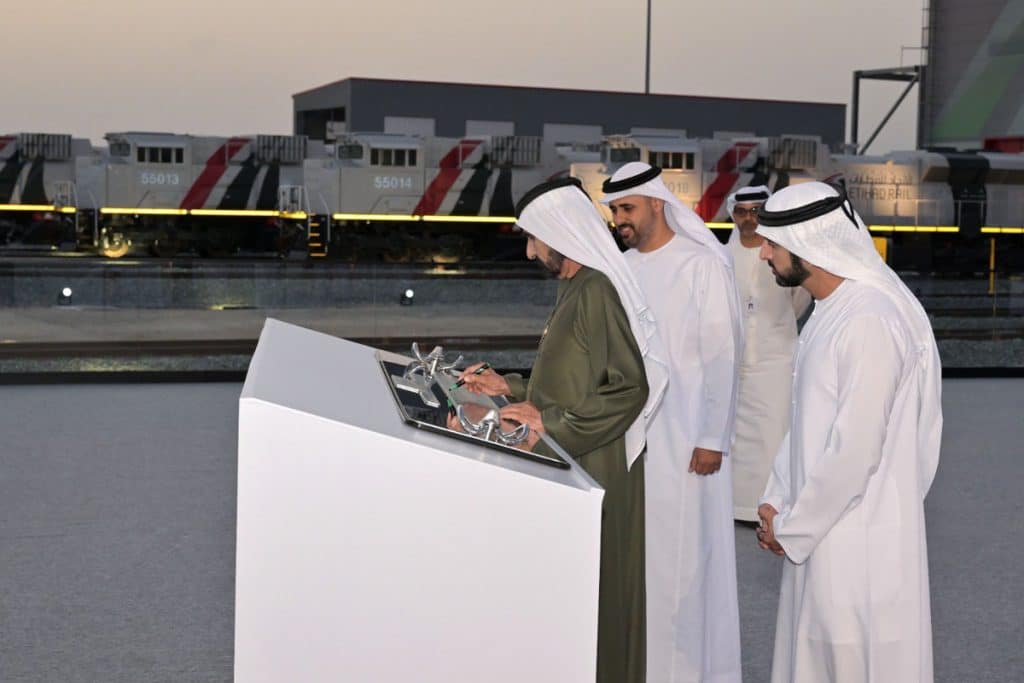
Sheikh Mohammed bin Rashid Al Maktoum, Vice President, Prime Minister of the UAE, and Ruler of Dubai, attended the opening ceremony of the railway’s central control and maintenance centre in Abu Dhabi, lauding the achievement as a significant milestone in the country’s development journey. The launch was held on Thursday, last week.
Sheikh Mohammed said: “We are proud of the performance of our sons and daughters who have worked hard over the years to build an ambitious strategic project that will propel our national economy to greater heights.
“Connecting the Emirates via a national railway network strengthens our capabilities and competitiveness, and consolidates our unity”.
The UAE National Rail Network is one of the largest infrastructure projects in the region, and it is intended to connect the seven emirates via a primary railway network.
The project’s successful completion is a testament to the talents of the UAE’s citizens and the support of its leadership.
The railway network has been built to international specifications, with a total of 38 locomotives and over 1,000 wagons that can transport all types of goods.
The main line of the UAE National Rail Network extends from Ghuweifat on the border of Saudi Arabia, to Fujairah, forming an essential part of the global supply network.
The first stage of the network has been fully operational since January 2016, while the second stage of the project started in early 2020.
The UAE national railway network will contribute to supporting the national economy at a value of AED200 billion ($54.5 billion), and saving AED8 billion ($2.2 billion) in the cost of road maintenance.
The network’s tourism benefits are estimated at AED23 billion ($6.3 billion).
The project has contributed to supporting the local industry by assigning 215 companies and local entities. also, 70 percent of the building materials used in the project are produced by the local industry.
The project also supports the UAE’s sustainable development goals and contributes to achieving the UAE Net Zero by 2050, through reducing carbon emissions in the road transport sector by 21 percent, and reducing road transportation emissions per capita by 40 percent, by 2050.
This national project contributed to supporting the Emiratisation agenda and graduating qualified Emirati recruits to work in the sector.
Emiratis are taking over a number of technical positions at Etihad Rail, including the roles of train captain, traffic controller, train inspector in addition to other specialisations.
11 contractors, 25 consultants, and 28,000 specialists worked on the project.
It took 133 million working hours to complete, and 40,000 approvals from 180 government agencies.
More than 1,000 operational documents have been produced, including instructions, handbooks, guidelines, policies, operating procedures, agreements, and others.
The UAE national railway network passes through a variety of geographical terrains, within a large-scale engineering plan that includes the construction of 593 bridges and crossings of all types, and 9 tunnels with a length of 6.5 km.
It took 120 million cubic metres of excavation work to complete, to ensure the highest levels of vehicular traffic flow under the tracks of the railway network.
The fleet of the most modern freight trains in the region includes 38 locomotives, with a capacity of 60 million tonnes of goods annually, and more than 1,000 multi-purpose vehicles.
Each goods transport’s locomotive operates with a power of 4,500 horsepower, equivalent to 3,400 kilowatts.
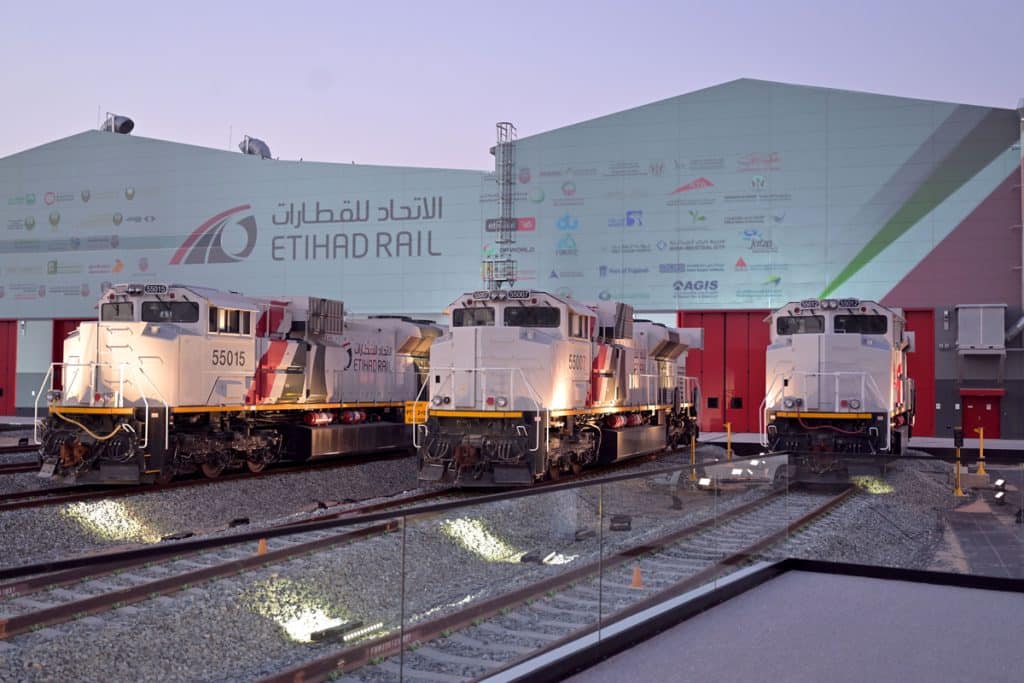
It is one of the most powerful freight train engines in the Middle East.
The freight trains will run up to 120 km/h. They have been specially designed to withstand the geographical nature, climatic conditions, high temperatures and humidity in the GCC region, to ensure high levels of performance, efficiency and sustainability.
The freight trains will connect four major ports and stop at seven logistics centres across the country, to serve trains and related businesses.
The network also includes a number of charging stations located in Ruwais, Industrial City of Abu Dhabi (ICAD), Khalifa Port, Dubai Industrial City, Jebel Ali Port, Al Ghail and Fujairah Port.
These locations are a major hub for local and regional distribution and logistics services, as it includes customs warehouses and on-site cargo inspection services.
The UAE national railway network will provide solutions for investors and customers, due to its ability to transport all types of goods, including petrochemicals, raw steel, limestone, cement, building materials, industrial and domestic waste, aluminium, food commodities, and general cargo.

The ambitious development project is one of the largest infrastructure projects in the region and aims to link the seven emirates with a main railway network.
Sheikh Mohammed also launched cargo train operations across all the emirates.
At the unveiling ceremony, Sheikh Theyab bin Mohamed bin Zayed Al Nahyan, Chairman of Etihad Rail, noted that the UAE is keen to strengthen its union though launching new mega projects such as the UAE National Railway Network, which connects the seven Emirates and accelerate the country’s economic development.
Sheikh Theyab said: “Emirati talents, with the support of the UAE leadership, have turned the dream of our founding fathers into reality.
“Thanks to them, we won the bet, and we succeeded in launching a railway network with international specifications that extends to about 900km across the Emirates.
“We announce the inauguration operation of the freight trains throughout the UAE with a fleet of 38 locomotives and more than 1,000 wagons capable of transporting all types of goods.”
He pointed out that the completion of the network according to the schedule and the approved budget, would not have been possible without talented Emirati recruits.
Follow us on

