



While in Dubai for a stint in the kitchen at Ronda Locatelli, Michelin-starred chef Giorgio Locatelli speaks to Lucy Taylor about why food needs “soul”.
During your stay in Dubai, you’ve been back in the kitchens of Ronda Locatelli at Atlantis The Palm – how’s the restaurant doing and what are your views on Dubai’s dining scene?
Good – it’s growing, it’s getting its own character. Obviously it’s quite a battle because we are part of this big, monster business here, and if some important [Atlantis] hotel guest comes to the restaurant and doesn’t see his usual spaghetti bolognaise, he might not be happy with the hotel.
I get that in London sometimes, but there if they are not happy about the choice on our menu, we can accept that. Some like us and some might not, but they have chosen to come to our restaurant. Whereas here, we are a restaurant providing a service for the hotel, which of course is an important part of our business.
This is a huge hotel, and in high-season there are a lot of people staying here and wanting to eat at the property, so we really want to give a service to these people, being the only Italian outlet here.
But we are working hard to make sure this doesn’t straighten out our character; we don’t want to become like any other Italian restaurant in Dubai, and there are a lot of them.
Some are good, but many of their menus are carbon copies, all delivering the typical dishes people expect.
I think it’s time to push the standards; Italian food in the UK 10 years ago was OK, but now if you come to London it’s incredible – because people have travelled around Italy so much over the past decade that they’re not going to want tagliatelle alfredo; they know no one eats tagliatelle alfredo, no one eats spaghetti bolognaise, and when they come to our restaurant, they want to try the speciality, to know which region it’s from. They are discovering the regionality of cooking. And I think Dubai will grow into that.
Of course there are a lot of tourists coming here, and as such we have a very international clientele, which must be fully turned to Dubai’s advantage.
But at the moment most restaurants here are in hotels, and some hotels can really suck the soul of a restaurant and take away from it.
For example, at Locanda Locatelli, the buck stops with me: if a customer isn’t happy, I deal with the situation. It is me who will tell them to go or sort it out.
But here, if there’s a guy who is staying in the Royal Suite, paying a lot of money, you’ve got to listen to them to an extent – and that can really deflate the importance of the restaurant.
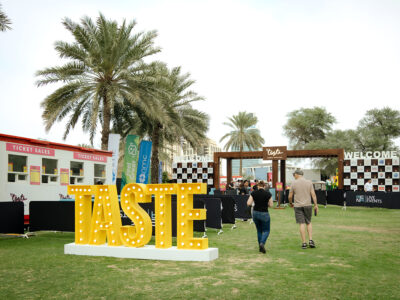
At the Taste of Dubai show earlier this year, you did a cooking demonstration with your mother; do you involve a lot of family recipes and dishes you grew up with in your current repertoire?
Now, certainly. When I started out as a chef, I wanted to be international, and learn new things, so I spent a big part of my early career travelling and learning in London, Paris, almost pulling back from my own traditional food.
Then when the time came that I decided I didn’t want to work for anybody anymore, and wanted to do my food, I went back to my roots – and things just progressed from there.
And I have found myself looking back into those flavours and memories from when I was young. It’s my experience and the ingredients which I found to be the most inspiring elements.
I see food in a very different light now: I’m not a kid anymore, I’m not a young man anymore, and I feel that this experience is something I can transmit.
The technicality and complexity of a dish shows off your technical skills, but at the end of the day it is the soul of the food that is really important. I wouldn’t take a recipe and just make it; I always try to put some strong roots into a dish.
Every year I go on holiday in Sicily, which is a great inspiration as well – it is a wonderful place and a great inspiration for me.
But I want to give the feeling that my food is not just a recipe, and when I talk to people I always say you have to live with and be happy with what you do.
A lot of people may not realise how important their memories of food during their childhood are, or how much impact they can have, but when these memories or emotions are made a part of your dish, people will understand the dish was not just a practical exercise, but an actual part of yourself you’re putting into it.
Of course some of it’s about ingredients and technical knowledge and following a recipe, but it’s about retaining a sense of truthfulness in your food. And that’s been a challenge here in Dubai, because when people come to our restaurant in London, they may have heard what you’re about, but here, we came over with 14 people from London and started the whole thing off with seven in the kitchen and seven in the front, and we had 78 people who didn’t know anything about our concept.
So in order to really educate them, it was important to convey those ideals that are inside us – and it is working.
Here in Dubai the people who work for us are sponge-like – they are just soaking up information from us. It is so exciting, to see them growing so much. Every time I come over I am impressed.
Do you have any plans to expand further, and open another outlet in the Middle East?
Well, now this place is taking shape, then yes, we would potentially like to do something else – perhaps in Abu Dhabi.
We were talking with some people about a development down there; there is the Institute of Italian Excellency, which covers Ferrari and Prada and so on, and a guy from there came down to see us and have a chat about whether we’d like to be a part of that.
So next time I come back I’m going to Abu Dhabi.
But there’s the issue that if you want to serve alcohol you have to put your place in a hotel, so we’ll have to find the right partner to work with, which is not easy – hotels can take your character away.
When I come here I concentrate on what I’m good at: running the restaurant and cooking. If I had to come here and have accounts meetings and so on that would be so time consuming, and I don’t know if I’d have the time to do that. I already have that in London.
But Zuma is a great example of a success story: it has character, because it’s outside a hotel and there is no other manager who is going to make a different decision based on a customer opinion card.
As a stand-alone, you can just accept that as a standard, maybe 5% of people won’t like it. So if I serve 1000 people and 50 complain, I’m still on target.
But a hotel is always trying to please everybody, which is not possible with something as personal as food.
What else have you got coming up in the future?
Well, we’ve got a selection of ingredients that we’ve got together, which we’re branding as Locatelli.
Then we’re also working with Kerzner, not only at Atlantis but as a general consultant for their Italian food offerings throughout the world. So we have a team working with One&Only too.
I have also had offers to go to Macau, and to the Far East, Singapore and China, so we’re looking into that too.
Slowly and organically we’re trying to grow our brand.
Follow us on

