






Even before the pandemic, employers had begun to really understand the importance of the mental wellbeing of their workforce, and the need for interventions beyond rebalancing working hours and promoting exercise.
Every year, 12 billion productive days are lost due to depression and anxiety, costing the global economy $1 trillion in lost productivity. GCC countries account for some $3.5 billion of those annual losses. Across the region, 15 percent of the population suffer from mental disorders in any given year – and those are just the cases that are disclosed.
Around the world, companies have taken action to improve employee mental health, identifying a clear correlation between healthy and happy employees and their engagement, productivity and loyalty. A recent study, for example, found a $4 return for every $1 invested in improving workforce mental health.
Time to act swiftly
Following the disruption and personal distress of the last two years, mental wellbeing at work has come to mean so much more than tackling anxiety and depression, or managing job-related stress. And as ‘wellness’ means something different to each of us, it makes it a complex issue to address.
The question of how best to personalise wellness in a corporate environment requires diversity and agility in approach, with cookie-cutting policies lacking engagement. However whilst employers have a duty of care to provide a positive and balanced work environment, the onus is also on us as individuals to take personal accountability for our own wellness, making it a shared responsibility.
With mental health issues on the rise and becoming more pervasive, visibility in both society and, by extension, in the workplace is increasing. This lack of visibility and burden of societal stigma up to now has been a big part of the problem – fortunately the urgency to redress this is palpable.
As employees increasingly reassess not only their options, but also their expectations and motivations towards work, employers have to act swiftly on their wellbeing agendas if they wish to hold on to and attract talent.
Recruitment implications as personal priorities shift
For many employees, the pandemic provided a new perspective on their life priorities. Having experienced the option to work from home, growing numbers have started to hanker for a better work-life balance. Others are still reviewing what matters most to them, and what they need from their career and from their workplace.
This trend is especially true in the Middle East. Our recent Hopes & Fears survey found that nearly a third (30 percent) of working-age respondents in GCC countries were ‘extremely likely’ or ‘very likely’ to look for a new job in the next year, compared with a global average of 19 percent.
Our research confirmed the role of improved wellbeing at work as a factor influencing whether people change jobs, with almost three-quarters of GCC respondents (71 percent) said this was ‘extremely’ or ‘very important’, compared with 60 percent globally.
Leading through innovation
There is a strong opportunity for employers in our region to take a lead. Up to now, only a third (33 percent) of Middle Eastern respondents felt that their employer provides support and resources to help them manage their own wellbeing.
Employers need to make this a priority, aligning coherent and responsive mental health strategies with the core business strategy. Leadership needs to speak up and share their own stories, taking a top-down approach to smashing stigma and cultivating a place of psychological safety at work.
Creating a board-appointment role such as my one – Chief Wellness Officer – will also help to ensure that optimising employees’ mental wellbeing becomes embedded within the firmwide DNA.
This is important not only because it is the right thing to do, with links to diversity and inclusion, and social and ethical agendas; but because if companies don’t invest in optimising mental wellbeing in the workplace, they risk being unable to attract and develop the talent they need to grow and prosper.
Investing in workplace support systems
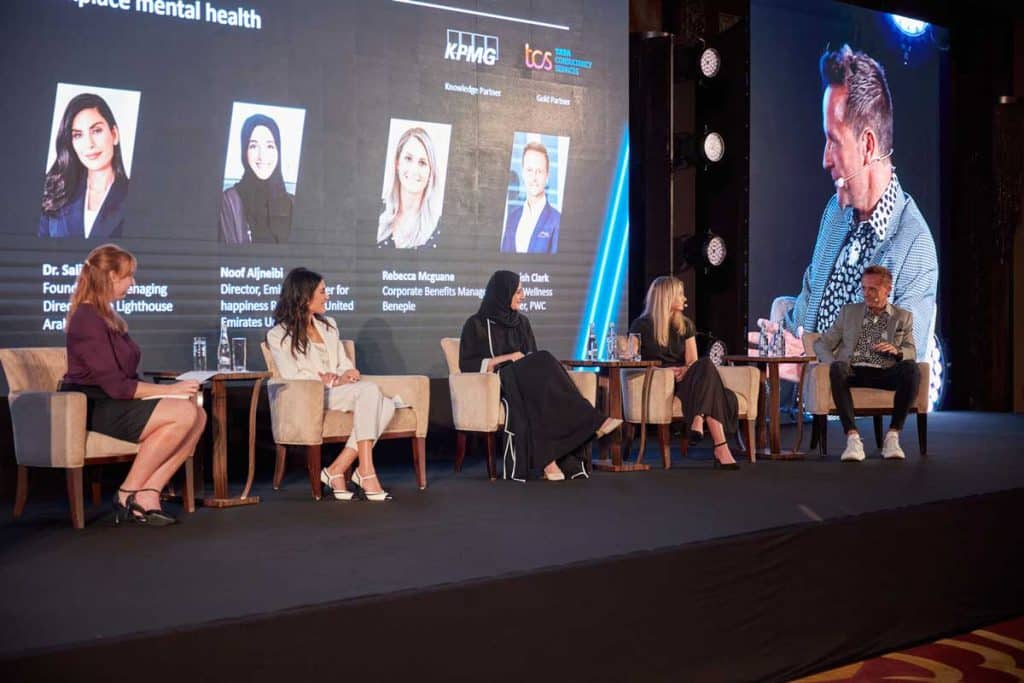
The recent panel discussion hosted by Arabian Business on ‘The ROI of workplace mental health’, examined a whole host of reasons to invest in workplace mental health, tangible and otherwise, such as increases in productivity, quality and loyalty, and reductions in absenteeism, presenteeism and recruitment costs.
During the session I spoke of our own work at PwC, with The LightHouse Arabia, training mental health first aiders to offer peer support to employees who are struggling. As much as anything, the change that is needed is for people to feel comfortable talking about their mental health, and recognising when they are experiencing problems before reaching a burn-out or crisis stage.
It was encouraging to hear from one of my fellow panellists that employees are feeling more confident utilising mental health insurance benefits where available, but more needs to be done to increase awareness and access to workplace support systems.
Certainly, Gen Z and Millennials are more open to discussing issues such as mental health, and this contingent will soon form the main part of the workforce. Amidst the ‘great resignation’, a competitive, progressive workplace must adapt its culture accordingly, and look at what we can all do now to make work a happier, healthier and more inclusive place to be.
Hamish Clark, Chief Wellness Officer at PwC Middle East
Follow us on

