


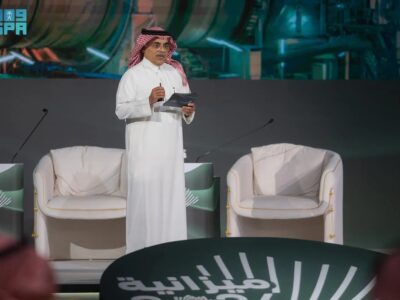

Mohammed Aljadaan, Saudi Arabia’s Minister of Finance, said the Kingdom will continue with “expansionary” spending, and it will continue to borrow as long as it can generate a return higher than the cost of borrowing.
The minister was answering queries at a press conference on Tuesday regarding the approval of Saudi Arabia’s general budget for the fiscal year 1447/1448 AH (2026), in which the total expenditure is expected to reach SAR1.313 trillion (US$350 billion). This will increase to approximately SAR1.419 trillion (US$380 billion) in 2028.
“Despite all spending on major strategies and projects, the government continues to focus on core services and their improvement to enhance services provided to citizens, including education, health, social services, and municipal services, which will reach SAR533 billion (US$142.1 billion),” the minister added.
Saudi signals ongoing expansionary spending
For 2025, the Saudi budget deficit was expected to be SAR245 billion (US$65.3 billion). Expenditure was estimated at SAR1.336 trillion (US$360 billion) and revenues at around SAR1.091 trillion (US$290 billion).
The minister said in the case of Saudi, the deficit was strategic and explained: “Budget deficits differ according to their purposes. For us in Saudi Arabia, during this period and in previous years, the deficit has been a targeted strategic deficit, based on a government policy that assessed the Kingdom’s economic capacity and financial strength to spend to achieve accomplishments, implement projects, and execute strategies, even if it required borrowing.
“The aim is for this borrowing of SAR245 billion to generate a return higher than its cost, which is what is happening in the Kingdom. Currently, economic growth, particularly in the non-oil sector, has averaged 5 per cent over the past four to five years.
“The returns on most of the expenditures we are making now will come in the coming years, not immediately. Therefore, it may be appropriate to continue, and this is what we will continue to do in the coming years. We will increase spending as long as the return on this spending exceeds the cost of borrowing.”
Saudi economy poised for strong growth
Minister Aljadaan also expected that by the end of 2025, real GDP growth would reach 4.4 per cent, and that nominal GDP would rise to reach SAR5.6 trillion by 2028.
The minister said that the Kingdom has not yet reached full sustainability, as government revenues are still affected by oil prices. He added that long-term sustainability will be achieved through meeting the targets of Saudi Vision 2030.
Minister Aljadaan provided a brief overview of Saudi Vision 2030, noting that 93 per cent of the vision’s targeted performance indicators have been achieved, or are on track and 299 indicators have met their targets ahead of 2030.
The minister praised the transformation brought about by Vision 2030, and also how various parties have worked to achieve its goals.
“The structural transformations in the economy that have occurred since the launch of the Saudi Vision 2030 are transformations that are usually difficult to achieve in economies over a short period like the one from the launch of the Vision,” said the minister.
“For example, private sector investment as a percentage of GDP has changed by approximately 40 per cent in a period of less than eight years since the actual implementation of the Vision began. It is extremely difficult to increase the private investment share in GDP by 40 per cent in such a timeframe, yet this has been achieved in the Kingdom.”
Aljadaan highlighted that the contribution of non-oil activities is remarkable in terms of its growth and described the Kingdom’s achievement of that figure reaching 55.4 per cent as “historic”.
Regarding spending on health and education, the minister noted that expenditures will exceed SAR460 billion next year, emphasizing that this does not conflict with privatisation.
Follow us on

