


It’s an appropriate setting for a meeting with a UAE government minister in 2021, particularly in late October, as thoughts turn towards the nation’s 50th anniversary.
We’re in a large meeting room on the 30-something floor of Central Park Towers in DIFC, the Dubai home of the Ministry of Economy, whose floor-to-ceiling windows offer vertiginous views of both the canyon of skyscrapers on Sheikh Zayed Road and also the vast expanses of desert beyond Ras Al Khor.
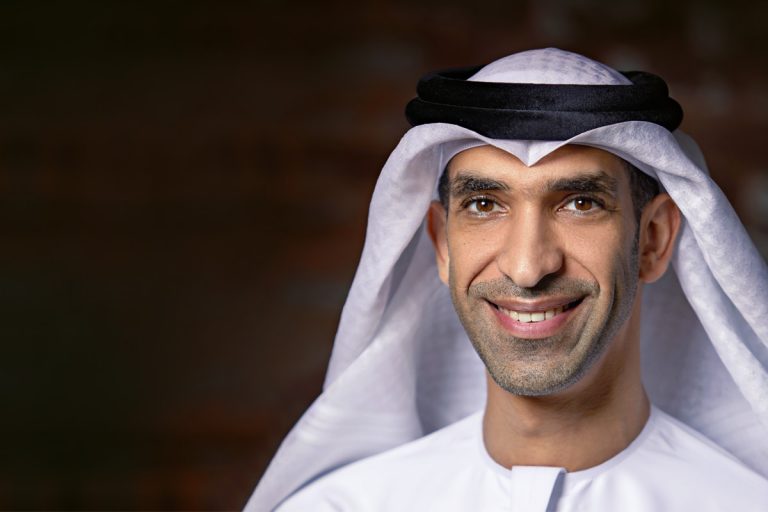
The development of the UAE in just five decades, from a loose federation of trading posts on the Arabian Gulf to a global economic powerhouse, is bewildering – and, from this height, tangible. There are, though, no plans to slow down, no sense of resting on any laurels. It’s a point that Dr Thani bin Ahmed Al Zeyoudi, Minister of State for Foreign Trade and Minister in charge of Talent Attraction and Retention, is keen to reassert during an exclusive sit-down with Arabian Business.
And he has a lot of ground to cover, from the ‘Projects of the 50’ and its various plans for economic and social improvement, through to the raft of trade negotiations his department has launched with Indonesia, India and South Korea. Trade and talent would, it seems, be providing much of the impetus for the next five decades of the UAE’s success.
You have announced the launch of talks with a number of nations that you hope will lead to Comprehensive Economic Partnership Agreements (CEPAs). What is the strategy behind this? How will the UAE benefit from CEPAs?
During the government’s reshuffle in 2020, in the middle of the pandemic, one of the main messages from His Highness was essentially that we are going to be one of the fastest economies in the world to recover. And at the same time, we’re going to prepare ourselves for the upcoming 50 years.
We’ve been carrying out an extensive benchmarking exercise globally, looking at what has boosted various economies around the world, what are the best practices when it comes to growing their economies. One of the main tactics, especially in the last decade, has been Comprehensive Economic Partnership Agreements, as well as Free Trade Agreements between many countries.
We looked at the growth in Singapore, Switzerland, Israel, and Indonesia as well, and saw that the openness of their economies has been one of the main drivers. What we have achieved in the last 50 years is down to that same openness, so continuing in that same manner is fundamental.
So, we have taken the decision to ensure that we’re going to further open up our market to the rest of the world. The whole world is now an open market and everyone is connected by the sea, by logistics and by alliances, and we have to ensure that we play our role as a global economic partner.

His Highness has set a very tough target for the UAE: He wants to double our economy in less than 10 years, and we have to ensure that foreign trade is an integral part of this significant development.
That’s why we’re going to move with the Comprehensive Economic Partnership Agreements, in which we deepen our bilateral relationships. It’s not only about the trade, commodities or services, but it’s about investments, government procurements, coping with the new norms, new ideas and innovations, sustainability aspects, as well as the movement of talent around the world.
So CEPAs aren’t FTAs. Can you explain the difference?
Free trade agreements really focus on two aspects, the commodities and the services, which have been the conventional practice globally.
The CEPAs are broader, they cover the trade aspects plus the services which we’re very strong on here in the country. But we’re also talking about government procurement, strategic investments, the protection of our own investments in these regions and countries.
They also cover SMEs, which are very crucial for modern economies. We have to ensure that we’re creating and attracting unicorns, that they can scale up. Entrepreneurship has an integral part to play in growth.
From a sustainability aspect, we’re seeing the discussion on carbon tax in Europe, which is pushing consumers, clients and manufacturers to change the way they’re running their industries. So I want to ensure that we’re embedding those principles in our industries and businesses so they don’t face barriers moving forward and smoothly integrate with the international ecosystem. So the CEPA is more comprehensive, it’s about ensuring that we move from being a regional nation to a global nation.

Where are we in the process? Which countries do you hope to open talks with next?
Our ultimate goal is to ensure that we’re connected to more than 95 percent of global trade and visitors. So, it’s not going to be limited to the countries we’re negotiating with, but will be with the whole world.
We have started with eight countries because of their initial reactions to our request. We’re talking to India and Indonesia, with whom we have already started the CEPA discussion and negotiations are going very well – we’re even expecting those to be finalised ahead of the agreed timeline. We started discussion with South Korea just a few days ago, and we’re starting soon with Israel. We’re in discussion with Turkey. We’re hosting the Joint Economic Committee meeting in November, so it’s going to be one of the main topics.
And we are talking with the UK, with Ethiopia and Kenya, so it’s a very broad selection of diverse countries.
What are the energy levels like, it seems that the UAE has created itself a window of opportunity through its handling of the pandemic?
What we have invested in the last 18 months is paying off now, through the huge investment in the health infrastructure, in vaccinations, the PCR testing and the way that we have handled the pandemic. That ensured that there is a smooth re-opening of our economy to the globe.
Plus, Expo 2020 is bringing a lot of traffic to the country, but it’s also bringing a lot of investments, potential collaborations, cultural and traditional engagements and partnerships with the rest of the world.
And at the same time, it is achieving the vision of the nation of being open. It’s sending a very positive message to everyone that there is hope even after such tough times. We have to work together to ensure that we come out from these times much stronger.

So, it’s all connected to stability. We’ve sent a very strong message that we’re very stable when it comes to the regulatory framework within the country. Then we went beyond that by modifying laws to ensure that we’re preparing ourselves for the next era.
For example, 100 percent foreign ownership, the residency system which has been totally revamped to include the green visa, which has been introduced lately, while residency criteria have been relaxed to help attract families and keep them here.
That all combines with the accessibility to all services, such as health, which is for anyone who is living in the country. We have a clear vision that we share with everyone which is ‘we want to grow’, that’s why we’re going to continue building and bringing the best to the nation.
In what way does this impact your commitments to the GCC?
We’re one of the main founders of the GCC secretariat and we’re engaging very closely with our colleagues at the GCC. If we’re talking about the overall economic negotiations for the region, we’re one of the main leads when it comes to those agreements, and we’re going to continue playing an integral role.
Any growth that happens in any country in the GCC will add value to the whole region.
Any new engagements globally by a member of the GCC will have a positive impact on the whole region. Through the CEPA portfolio, we’re ensuring that we’re bringing the best practices, mindsets, businesses and technologies to the whole GCC.

FDIs are a key part of the strategy. What sectors in the UAE are you hoping to enhance/accelerate through FDI?
Well, there are so many sectors that we’re focusing on, and the beauty of the UAE is that each emirate has its own focus on a certain sector. But, overall, the industrial and advanced science and technologies are among the main sectors that we’re looking at.
Just a few months ago, we launched our manufacturing strategy to ensure we raise its contribution to the UAE’s GDP over the next 10 years. And, we want to bring the Fourth Industrial Revolution technologies, such as robotics, AI and 3D printing, to our businesses in the UAE.
Healthcare is also crucial, not only investing in equipment and hospital services and providers during the pandemic, but also making sure that access to high-quality services is there as well.
The pharmaceutical sector is also very crucial, as well as food security and agriculture. And, for sure, the energy sector is going to be an integral part of investments either in the downstream or in clean energy and sustainability aspects.
What about FDI outflows? What sectors is the UAE looking to invest in?
Globally our historical investments have focused on real estate infrastructure and the energy sector. Lately, we have started integrating new sectors into our investments, such as fintech, pharmaceuticals, biotechnology, such as the huge announcements with the UK, the £800m ($1.08bn) investment in life sciences. Let’s also not forget sustainable and clean energy. Renewables, including green and blue hydrogen, have dominated most of our bilateral discussions during Expo.

What are the incentives and strategic advantages for companies investing in the UAE?
We’re ensuring that we’re building on the success we have achieved so far, the openness in the country, but also the logistics and the infrastructure, which we have built. We’re going to continue building and reforming that, from bridges, roads, schools, hospitals, shopping malls, ports, airlines, etc. These will connect us to the world.
When His Highness, the founder of the UAE Sheikh Zayed Bin Sultan Al Nahyan, established the nation, he was always pushing for our people to be the DNA of this nation. Our transformation came through his personal focus on the human being, through investments in locals, and, at the same time, attracting the right mindsets and expertise to the country.
Our leaders are moving in the same direction, the human element is always crucial. We want to ensure that coexistence and tolerance are always maintained, these are the principles that we’ve taken forward on every step of our journey.
With our residency system, we modified and improved this in close coordination with businesses and communities to make sure they really considered the UAE home for themselves and their families.
If we speak again in five years’ time, what impact will these CEPAs have had on the UAE’s economic landscape?
I really hope that we’re going to be halfway, or better, towards the doubling of our economy. We’re expecting trade to be double the current number. Our investment abroad will be diversified, and we’ll have a lot of billionaires and businesspeople based and working in the UAE. Equally, going back to the SMEs and unicorns, we want to see 15 to 20 unicorns coming out of the UAE.

From trade to talent
Dr Thani bin Ahmed Al Zeyoudi is the UAE Minister of State for Foreign Trade and Minister in charge of Talent Attraction and Retention. The role remit covers the following responsibilities:
- Leading the development and expansion of the country’s non-oil foreign trade, including spear-heading the nation’s bilateral trade agenda.
- Facilitating increased inflows of FDI to the UAE.
- Facilitating opportunities for outbound FDI, particularly in strategic sectors.
- Implementing initiatives to attract and retain strategic global talent in the UAE.
“The Ministry of Economy understands that our economic success over the next 50 years will be built on three forms of capital: human, financial and technological. This is reflected in the ‘Projects of the 50’, the national initiative for the next 50 years, which prioritises trade relationships with key global partners, foreign direct investment, integrating advanced technologies across our industrial sector, and attracting and retaining the brightest talent,” Dr Al Zeyoudi says of his broad remit.
“To us, these goals are inextricably linked: we can only secure sustainable growth if we have a flexible, dynamic business environment able to foster the industries of the future, a skilled workforce, and frictionless access to the opportunities available in the Middle East, Africa and Asia.”
Follow us on

